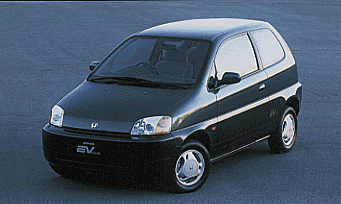
HONDA CRV 2013 AutoCars Honda Civic | Honda Accord, Honda City, Honda Brio, Honda Amaze, Honda odyssey, Honda Assure, Honda Auto Terrace, Honda Customer Jazz, New Honda Cars in United States/America/USA, Canada, United Kingdom, France, Germany, Spain, Italy, India, Japan

Showing posts with label Honda Electric Car. Show all posts

Honda Cars : Honda President Sees Limited Role for Electric Cars | 2013 New Honda Car Reviews 0

Unknown | 7:14 AM
Honda Electric Car
Honda Electric Car

Very interesting read....
By Brad Berman
onda’s display at the 2011 Tokyo Auto Show is full of electric car concepts. Earlier this week, international journalists were given the opportunity to drive its impressive Fit EV pure battery electric car. So, when given the opportunity to ask a single question at yesterday’s press conference with Honda President Takanobu Ito at the Tokyo show, I tried to determine if the company’s man at the top has a vision for electric cars.

I’ll let Mr. Ito speak for himself in this unedited transcript of my question and his answer.
In your earlier comments, you identified the need for Honda to be ahead of your competitors on technology, especially hybrid and electric. Nissan is projecting to have 1.5 million cumulative sales of electric cars by 2015. What do you think of this forecast, and Honda’s ability to compete with pure electric vehicles?

First of all, just because Nissan is saying it’s going to sell some 1.5 million pure EVs, Honda is not going to say that [we are] as well. Instead, our way of thinking is, for us to contribute to sustainable society, we have to think about total sales of Honda vehicles, and thereby through our products, contribute to society.

With this in mind, compared to the year 2000, we need to reduce our CO2 emissions by 2020 by 30 percent. Pure battery EVs, of course, would be one means of trying to reduce CO2. I think there is no mistake about that.

I think the way people use cars is not the same across the board in all countries, so I cannot generalize. If you think about the concept EVs introduced by Honda at this Tokyo Motor Show, you see that electric cars are important. I will not deny that. But when you consider the performance of batteries, the charging times, plus the cost of batteries, I think pure EVs would be best for compact, very small cars.

I feel confident in saying that they could be a fit for very small vehicles. That is why last year we launched the motorcycle EV. We think we should expand on this and for mini-vehicles, an even smaller size category—the commuter car we introduced at the Tokyo Motor Show, which would be well suited for a pure EV.

Will this be acceptable in the United States? This is a question. Therefore, we are thinking of the Fit EV for the United States. But for Japan, Europe, and other parts of Asia—especially the urban areas, we think the smaller category would be an option that could be considered, if it could be easily charged and has good maneuverability. In this category, pure EVs would be appropriate.

So, we’ll start with the very small cars for the pure battery EVs. But when you think about other segments—compact cars and large vehicles—in order to contribute to sustainable society, fuel economy and reduction of CO2, I believe hybrids would be the best.

When I say hybrids, there are different types of hybrids. Honda has to think about what would be best for each of the categories. For example, we have strength in the one-motor system—a very simple IMA (Integrated Motor Assist). This is one thing that we feel is fit for this purpose. We think we can increase the number of sales, and we are preparing the next version of the IMA, trying to improve the performance.

For vehicles in the United States, say the Accord class, we have to secure sufficient motor performance. We have to further work on this to generate enough power during the driving. For this, we have to have a separate dedicated system for the Accord class and above.

If you’re talking about high-end expensive vehicles, fuel economy is not enough. It also has to be fun to drive. For that we have the SH-AWD [Honda’s new hybrid system primarily dedicated to enhancing driving dynamics]. For each class of car, there are different types of hybrids. We believe we already have the technology in our hands, and for the next 10 to 20 years, I think in order to reduce CO2, we would have to use these different technologies, of which pure battery cars are one. But proportion-wise, I think hybrids will be the largest.

What Gets His Motor Going
In the final question of the session, an American journalist followed up on the idea of Honda adding “more fun” to its vehicles—a notion that was frequently discussed in presentations to journalists in the past few days in Tokyo. The journalist mentioned Honda’s electric sports car concept on display.

“I would love to have an electric sports car, but I live in an apartment complex, so I’d have to run an extension cord across my parking lot in order to recharge it,” he said. “[Honda] used to have affordable sports coupes that were iconic around the world, the CRX, the Integra, Prelude, those cars that every man could afford that actually ran on gas. Is a car like that on the table, or does every future sports car need to have some sort of advanced powertrain. It seems like a gas powertrain might be more affordable to the masses.”

Mr. Ito broke into a smile and, for the first time in the one-hour conference, delivered his response in English—a single line: “I completely agree with you.”

Source;
http://www.plugincars.com/honda-president-sees-limited-role-electric-cars-110639.html


, , , , , , , ,

Honda Cars : Honda Reinvents Regenerative Braking for Fit EV | 2013 New Honda Car Reviews 0

Unknown | 9:06 AM
Honda Electric Car
Honda Electric Car


By Brad Berman
As we discussed in October, the secret sauce of a good electric car is not how it accelerates, but how it brakes. Yesterday, I had two short rides in the Honda Fit EV at the company’s Twin Ring Motegi complex north of Tokyo—prior to my visit to the 2011 Tokyo Motor Show today. My driving impressions from behind the wheel are embargoed until Dec. 5—but I’m free to report on my discussion with Kunimichi Hatano, the engineer who created Honda’s new regenerative braking system.

Honda’s strategy rests somewhere between what Ford will do with the Focus Electric—make it feel like any conventional car without special modes or gears—and BMW’s strategy. Electric Bimmers will brake in an aggressive and distinct way, according to Aaron Singer, BMW product strategy manager. The Fit EV's braking is perhaps most similar to the one found in the Nissan LEAF, with a couple of key exceptions. Honda’s Mr. Hatano explained that the goal is to make the brake feel comfortable and familiar—yet the Fit EV will have a “B” gear, providing the driver the choice to engage an aggressive motor-only regen setting, as well as an “Econ” mode that removes regenerative braking in a coasting-type function. The current LEAF lacks such driver-managed controls.

Again, I can’t speak yet about the relative level of performance achieved when toggling between Normal, Sport and Econ modes. But what’s important here is the role that Honda’s new electro-servo brake system—the first of its kind—in yielding about 75 miles of real-world range, and123 miles of range (in the forgiving LA4 cycle). The Fit combines a 94 kW motor and 20 kWh battery pack. (Honda is not yet sharing details about the weight of the Fit EV, but it's bound to be lighter than the LEAF.)

So far, the Fit EV is the only Honda car that has been (ahem) fitted with the new system, but it is also slated to go into Honda’s upcoming Accord-sized plug-in hybrid—which I also was able to drive yesterday.

Here’s an excerpt from my conversation with Mr. Hatano.

Many EV drivers like very aggressive regenerative braking. Why not give a unique aggressive feel to regen braking in your electric vehicles?
Honda does not intend to reduce the amount of regenerative braking to achieve satisfactory brake feeling. Obviously, we want to recuperate as much energy as possible. But if you try to recuperate too much energy, you might destabilize the vehicle. The question is how much energy can we recuperate without going over the threshold of losing stability. You have to bear in mind that vehicles are driven under bad weather, in snow, and rain, and when the road surface might not be good. You have to make sure the regenerative braking doesn’t go beyond what is reasonable.

But it can feel different and still be safe, right?
Sure, some prefer a different feeling. Whatever kind of brake feel you want—whether it’s like normal gasoline-powered cars or different—that’s one subject. And the limit of regenerative braking is another subject. The limit is more about preserving stability. Because this is an electric braking system, you can fine-tune the taste in many different ways.

How is the electro-servo braking system different than its predecessors?
In our system, you have two different main parts. In the first part, you create the brake feel. This is quite common with other carmakers. The way our brakes feel might be different, but the system is not very different. However, what is different is the part that actuates the brakes. Traditional hydraulic brakes use a vacuum to activate the brake system, and then pump oil to press the pads against the rotor. A hybrid system may use solenoids. Our new system is different because the medium to apply the brakes is using an electric motor to directly drive the pump that serves the brake fluid.

What’s the advantage?
This system has very high accuracy. This means more efficiency. It’s more faithful to the brake input from the driver. [Honda estimates that the servo-based system increasing efficiency by at least 5 percent.]

When you take your foot off the accelerator, you immediately have a little bit of regenerative braking. Then, you put your foot on the brake—and if you look at the curve on the hydraulic system, it goes up very sharply. But if you look at the yellow zone in the graph, [in the old system] the regeneration doesn’t go up as sharply and it’s delayed. The idea of the new system is to bring the regenerative yellow zone closer to the hydraulic response.

The first part of the slope is very similar to the hydraulic. Then, as you start reaching the regeneration limit, the slope gradually slows down a little and reaches the limit after what the hydraulic system can do. After that, you can keep regeneration system at the highest level longer than the current system. And just before you stop, the drop is even sharper than the old regeneration system.

All of this is possible because of the servo system? Could you have done this just with calibration?
No, you need the accuracy to achieve it.

Does the increased regenerative braking mean slowing down faster?
The braking distance itself is not shortened by this alone. The braking distance is determined by the weight of the vehicle, the speed, and the amount of energy you take out either by regenerative braking or traditional braking, and the tire grip. This system doesn’t mean that you’ll shorten the braking distance. That depends on the caliper or other brake operations.
How does the “B” gear mode affect regenerative braking?

B is for higher regeneration only when the throttle is off. If you are in B mode, it's only regenerating energy through negative torque at the motor level. [There’s no use of the brakes.]

And what’s the effect of Econ mode?
In the econ mode, on the contrary, it reduces the engine brake effect so the car can coast. The idea is to reduce the up and down demands on the engine—by having less engine braking, which means you don’t lose as much as speed.

The B mode is made to suit certain driving situations, like when you’re going down a slope and you see a red light at the end. You put it in B to recuperate energy, so you slow down, which is fine. And if you see the light changes to green, you just put it back into D. It’s a question of responding to all possible driving situations.

Postscript
I can guess that many PluginCars.com readers will like the sound of Honda’s approach—but the nagging question remains: Why is the company only producing 1,100 Fit EVs over the next three years, and not allowing customers who might fall in love with the car the ability to keep it beyond the lease period? Company officials here repeated the same “one step at a time” message—that they want to learn as much as possible from the first customers in order to refine the car into the best possible EV.

I spoke with multiple high-ranking executives to encourage them to reconsider—especially if it looks like the Fit EV is a winner. It’s too early to know, but I have a glimmer of hope that Honda could reconsider its lease-only approach and/or increase production. If indeed the Fit EV represents an improvement in electric car braking, along with controls for higher regen and coasting, it will only be a matter of time before competitors offer similar features in their battery-powered cars. Honda's apparent technology and feature advantage could evaporate in three years, just as the company is collecting and processing feedback from the 1,100 Fit EV leaseholders who have the distinction of driving the car. That would be a shame.

Source;
http://www.plugincars.com/honda-reinvents-regenerative-braking-fit-ev-110596.htmlource;
http://www.plugincars.com/honda-reinvents-regenerative-braking-fit-ev-110596.html


, , , , , , , ,

Honda Cars : 2013 Honda FIT EV Concept | 2013 New Honda Car Reviews 0

Unknown | 7:24 AM
Honda Electric Car
Honda Electric Car


Honda today unveiled the all-new 2013 Fit EV at the Los Angeles Auto Show, announcing plans to begin leasing the 123 city-mile per charge (76 mile range combined adjusted city/highway)1 battery electric commuter vehicle to its U.S. customers in the summer of 2012. The Fit EV is based on the popular Fit hatchback and is a part of the company's diverse portfolio of alternative fuel vehicles that includes gasoline-electric hybrid, plug-in hybrid, fuel cell-electric and natural gas-powered models.

American Honda will begin leasing the Fit EV to customers in select California and Oregon markets next summer, and will expand to six East Coast markets in early 2013. The Fit EV's Manufacturer's Suggested Retail Price2 (MSRP) is $36,625 with an estimated lease priced at $399 a month. Honda will monitor market acceptance, but expects volume at this early stage of production to be approximately 1,100 Fit EV's over the next three years.

"The Fit EV is the next critical step in Honda's portfolio approach to alternative fueled vehicles," said John Mendel, executive vice president of sales, American Honda Motor Co., Inc. "There is no other automaker on the planet whose spirit is more deeply invested in the effort to realize a cleaner, more energy-efficient and ultimately more sustainable transportation future than Honda."

Customers interested in leasing a Fit EV are encouraged to sign up at www.FitEV.Honda.com where they can receive more information and sign up for the opportunity to become a future Fit EV customer.

Fit EV Performance
The Fit EV is designed to meet the needs of an average urban commuter, offering an estimated driving range of 123-miles on a single charge using the US EPA city cycle test methods (Honda anticipates a combined city/highway EV range of 76 miles on the new Fuel Economy labels) 1. The Fit EV will be powered by a 20 kWh lithium-ion battery and a 92 kilowatt coaxial electric motor. The high density electric motor, derived from the motor used in the FCX Clarity fuel cell electric vehicle, delivers excellent efficiency and power while remaining quiet at high speeds.

Driving range of the Fit EV can be maximized by using several innovative features, including a 3- mode electric drive system, adapted from the CR-Z Sport Hybrid. The system allows the driver to select between Econ, Normal and Sport to instantly and seamlessly change the driving experience to maximize efficiency or improve acceleration. While in Econ mode, practical driving range can increase by as much as 17-percent compared to driving in Normal mode. Acceleration improves significantly when in Sport mode, adding to the Fit EV's fun to drive nature.

In addition to the 3-mode driving system, the Fit EV includes interactive coaching features designed to assist the driver in maximizing battery performance and driving range. The power meter alerts the driver to optimal driving conditions. Additional energy- saving features includes a highly efficient electric air conditioning system and new regenerative braking system.

The 6.6 kW, onboard 32 amp charger allows for convenient recharging of the Fit EV. With a 240-volt charger, the Fit EV can fully recharge in as little as three hours. At launch timing, Honda will have a preferred Electric Vehicle Supply Equipment (EVSE) charging supplier.

Fit EV Exterior and Interior Styling
The exterior dimensions of the Fit EV are identical to the gasoline-powered Fit with the addition of a higher hip point to accommodate the under floor placement of the 20 kWh battery. When the car launches in summer 2012, it will be available in one exclusive color, Reflection Blue Pearl. EV badges on the rear hatch and decals on the side of the vehicle distinguish the electric vehicle from its gasoline counterpart.

The Fit EV carries a familiar chrome front fascia that is similar to other Honda environmentally-responsible vehicles like the FCX Clarity fuel cell electric vehicle and Insight hybrid. The Fit EV is outfitted with distinct five-spoke alloy wheels and an aerodynamic rear spoiler.

In the passenger cabin, the seating surfaces are covered with bio-fabric. The Fit EV features illuminated meters that alert the driver to key vehicle functions including state of charge, battery usage and driving range. The meters change color depending on the driving mode selected (green, white or red).

The Fit EV features a spacious and functional cabin with comfortable seating for up to five passengers. For enhanced versatility, the Fit EV offers multiple seating and cargo-carrying configurations.

Fit EV Telematics and Interactive Remote
To help the driver manage the electric vehicle ownership experience, the Fit EV will have a standard telematics system that allows the driver to stay connected through a smartphone, personal computer or interactive remote. Through the Fit EV smartphone and computer applications, the driver can remotely view the vehicles state of charge, initiate charging and activate the air conditioning and heater, to pre-condition the vehicle while connected to the grid which maximizes battery range on start-up. The mobile application and website also offers the ability to set charging notifications and alerts to optimize charging times based on varying utility rates and provides access to 24-hour roadside assistance. The Fit EV will come equipped with a standard Honda Satellite-Linked Navigation System™ that provides the ability to locate public charging stations and frequently updated traffic information.

The interactive remote allows the driver to monitor the vehicles state of charge and cabin temperature. Additionally, the driver can initiate and terminate charging and remotely turn on the air conditioning using the interactive remote. The interactive remote does not require an internet or mobile connection to operate however the driver must be within 100 feet (30 meters) of the vehicle.

Honda Electric Vehicle Demonstration Program
Honda will test the Fit EV with the City of Torrance, California Google Inc. and Stanford University as a part of the Honda Electric Vehicle Demonstration Program. Each program participant will provide Honda with real-world feedback on the Fit EV. Individually, each participant will use the Fit EV to further initiatives such as research into human behavior and various usage like personal, fleet and car-sharing.

Honda Environmental Leadership
In addition to the Fit EV, Honda is a leader in the development of leading-edge technologies to improve fuel efficiency and reduce CO2 emissions.

Honda has led the Union of Concerned Scientists (UCS) rankings of overall vehicle environmental performance since 2000, and a Honda vehicle has topped the list of America's greenest vehicles, from the America Council for an Energy-Efficient Economy (ACEEE), for eleven consecutive years.

In 2006, Honda became the first automaker to announce voluntary CO2 emissions reduction targets for its global fleet of automobile, powersports and power equipment products and its global network of manufacturing plants. Today, the company is striving for even greater reductions in CO2 emissions that contribute to global climate change, while also working to minimize waste, water use and the total environmental footprint of its operations worldwide.

For more information and high resolution images of the Fit EV, please visit www.hondanews.com.


, , , , , , , ,

Honda Cars : World Debut of Honda Fit EV Concept Electric Vehicle and Plug-in Hybrid Platform at Los Angeles Auto Show | 2013 New Honda Car Reviews 0

Unknown | 7:02 AM
Honda Electric Car
Honda Electric Car

Wow, this will be a nice addition to the Honda lineup, I am glad now that we're not getting the Fit Hyrid!
Honda today unveiled the all-new Fit EV Concept electric vehicle and the platform for a midsize plug-in hybrid vehicle. Both vehicles are integral to the Honda Electric Mobility Network, the company's comprehensive approach to reducing CO2 emissions through innovative products, energy-management and energy-production technologies.

The Fit EV Concept hints strongly at the direction and styling for Honda's upcoming production Fit EV all-electric vehicle, which will be introduced to the U.S. and Japan in 2012. The all-new plug-in hybrid platform showcases Honda's next-generation, two-motor hybrid technology set to debut in 2012.

"Honda's long history with electromotive technologies has enabled us to understand customer requirements," said Takanobu Ito, Honda Motor Co., Ltd. President and CEO. "In Honda's view, an electric vehicle must offer great utility and be fun to drive. Fit EV's urban commuting capability will be a perfect addition to the full-function mobility of the plug-in hybrid and FCX Clarity fuel cell electric vehicle."

Honda Fit EV
The Fit EV is designed to meet the daily driving needs of the average metropolitan commuter and utilizes the same 5-passenger layout found in the popular Fit hatchback. When the Fit EV production model is introduced, it will be powered by a lithium-ion battery and coaxial electric motor.

The high-density motor, derived from the FCX Clarity fuel cell electric vehicle, delivers excellent efficiency and power while remaining quiet at high speeds. The Fit EV will have a top speed of 90 mph.

The Fit EV will achieve an estimated 100-mile driving range per charge using the US EPA LA4* city cycle (70 miles when applying EPA's adjustment factor). Driving range can be maximized by use of an innovative 3-mode electric drive system, adapted from the 2011 Honda CR-Z sport hybrid. The system allows the driver to select between Econ, Normal, and Sport to instantly and seamlessly change the driving experience to maximize efficiency or improve acceleration. While in Econ mode, practical driving range can increase by as much as 17 percent, compared to driving in Normal mode, and up to 25 percent compared to driving in Sport mode. Acceleration improves significantly when in Sport mode, generating performance similar to a vehicle equipped with a 2.0-liter gasoline engine.

In addition to the 3-mode E-Drive system, the Fit EV will include several interactive coaching systems to assist the driver in maximizing battery range.

A special meter display advises the driver when to shut off air conditioning and other accessories to conserve battery power.

To help the driver manage the electric vehicle ownership experience, the Fit EV will have a standard connectivity system that allows the driver to stay connected through a smartphone and personal computer, or the Honda-exclusive interactive remote, while away from the vehicle. The pocket-friendly, interactive remote provides connectivity to the vehicle without the need for an internet connection or mobile phone signal. Through the connectivity system, drivers will be able to remotely view the vehicle's state of charge, initiate charging and activate the air conditioning, even while connected to the grid, to reduce the drain on the battery at start-up. The mobile application and website also offers the ability to set charging notifications and alerts to optimize utility rates, and provides 24-hour roadside assistance, along with a public charging station locator. The Fit EV will come equipped with a standard Honda Satellite Linked Navigation System™ that includes a public charging-station locator capability.

The Fit EV is designed to be easy and convenient to charge. Battery recharging can be accomplished in less than 12 hours when using a conventional 120-volt outlet, and less than six hours when using a 240-volt outlet. The Fit EV Concept displayed at the Los Angeles Auto Show features an exclusive Deep Clear Blue Pearl exterior color and distinctive five-spoke aluminum-alloy wheels with blue inserts. The Concept has unique LED headlights, a chrome front fascia, aerodynamic bumper, clear LED taillights and EV decals. Inside, the Fit EV Concept is outfitted in an eco-friendly gray bio-fabric on the seating surfaces.

Displayed alongside the Fit EV Concept at the show is a prototype Honda charging stand. To begin charging, the driver swipes a card in front of the screen and then connects the charger to the vehicle. The Honda charging stand provides a glimpse at the future of an electric-charging infrastructure that is easy to use and intuitive for consumers.

Honda Plug-in Hybrid
Honda also unveiled a plug-in hybrid platform, which showcases Honda's next-generation two-motor hybrid system. Integrated into a mid-size sedan platform, the plug-in hybrid is designed to be compatible with daily driving habits, allowing for short, frequent trips in all-electric mode, while providing long-distance driving capability when needed. The Honda two-motor system continuously moves through three different modes to maximize driving efficiency: all-electric, gasoline-electric and a unique, engine direct-drive mode. The plug-in hybrid also uses regenerative braking to charge the battery.

In all-electric mode, the vehicle uses a 6kWh lithium-ion battery and a powerful 120 kW electric motor. The all-electric mode achieves a range of approximately 10-15 miles in city driving and a top speed of 62 mph. Fully recharging the battery will take 2 to 2.5 hours using a 120-volt outlet and 1 to 1.5 hours using a 240-volt outlet.

The vehicle can also run in a gasoline-electric hybrid mode, the platform features a fuel-efficient 2.0-liter, i-VTEC® inline 4-cylinder, Atkinson cycle engine, paired with an electric Continuously Variable Transmission (E-CVT). An onboard generator adds to the battery powering the electric motor.

For more efficient high-speed cruising, the vehicle can engage in a direct-drive mode, in which only the engine drives the front wheels.

Advanced Technology Demonstration Program
Honda will launch an Advanced Technology Demonstration Program this year to provide real-world testing of its new vehicles, as well as research into customer behavior and usability, public charging infrastructure planning and sustainability initiatives. Partners in the program will include Stanford University, City of Torrance, Calif. and Google, Inc.

Honda Electric Mobility Network and Energy ManagementTogether with the Honda FCX Clarity fuel cell electric vehicle, the Fit EV and the future plug-in hybrid vehicle are a part of the company's comprehensive approach to reducing CO2 emissions. Honda is unique in its efforts to create both environmentally-responsible products and the renewable energy solutions to power them. Honda is currently producing and marketing thin-film solar panels in Japan, and an installation is planned at Honda Performance Development in Southern California in early 2011.

Honda is also using innovative ways to produce and distribute energy through sustainable methods, such as using solar power to produce hydrogen fuel from water. Additionally, Honda is developing home energy-management systems that utilize micro-cogeneration technology and solar cell modules to power and heat homes as well as charge electric vehicles. The Honda Electric Mobility Network joins clean vehicle technology, renewable energy production and energy management solutions for the benefit of customers and society.

Honda Environmental Leadership
The Fit EV and a plug-in hybrid sedan will be introduced to the U.S. and Japan in 2012, joining Honda's diverse lineup of environmentally-responsible vehicles, which include the FCX Clarity fuel cell electric vehicle, the Civic GX compressed natural gas-powered sedan (U.S. only) and four distinct gasoline-electric hybrid models: Civic Hybrid; CR-Z sport hybrid; Insight hybrid and Fit Hybrid (Japan and Europe only).

Honda was recently named America's "Greenest Automaker" for the fifth consecutive time by the Union of Concerned Scientists (UCS). The award is earned by the company with the lowest combined smog-forming and greenhouse-gas emissions (primarily CO2) in its U.S. automobile fleet.

Honda has led the UCS rankings of overall vehicle environmental performance since the first UCS study in 2000, marking a decade of Honda leadership in reduced vehicle emissions. Honda earned the recognition this year with an industry-best score based on model year 2008 data, the latest available for analysis.

American Honda Motor Co., Inc.
Honda began operations in the U.S. in 1959 with the establishment of American Honda Motor Co., Inc., Honda's first overseas subsidiary. Honda began U.S. production of motorcycles in 1979 and automobiles in 1982. With nine U.S. plants, Honda has invested more than $12.7 billion in its U.S. operations. The company employs nearly 25,000 associates and annually purchases $12 billion in parts and materials from more than 530 U.S. suppliers. Honda vehicles are manufactured using domestic and globally sourced parts.

Source;
http://hondanews.com/channels/honda-automobiles/releases/world-debut-of-honda-fit-ev-concept-electric-vehicle-and-plug-in-hybrid-platform-at-los-angeles-auto-show


, , , , , , , , , ,

Honda Cars : L.A. auto show: Honda to reveal electric concept | 2013 New Honda Car Reviews 0

Unknown | 11:25 AM
Honda Electric Car
Honda Electric Car

Honda will unveil an electric-vehicle concept on Nov. 17 at the Los Angeles auto show. It will be accompanied by a new platform that shows off Honda's latest plug-in developments.

Honda Motor Co. Ltd. president and CEO Takanobu Ito will be at the press conference, marking the first time the company's global CEO has made a product reveal in Los Angeles.

The show is expected to feature about 20 global reveals, organizers said on Wednesday.

Source;
http://www.autoweek.com/article/20101027/LOSANGELES/101029900


, , , , , , , , ,

Honda Cars : Honda turns to China to develop electric vehicles | 2013 New Honda Car Reviews 0

Unknown | 7:03 AM
Honda Electric Car
Honda Electric Car

Historically, Honda has been identified as a leader in environmentally friendly and high-efficiency vehicles, but recently the automaker has struggled to deliver class-leading products, and due to policy choices, risks falling further behind the competition.

Toyota has established itself as a strong leader in the hybrid market, offering numerous hybrid vehicles, including the class-leading Prius gas-electric hybrid. Honda, by contrast, lagged behind Toyota and the rest of the market introducing hybrid vehicles, and those it has introduced have failed to make meaningful impacts either technologically, or in sales.

Other automakers, such as Ford with its Escape and Fusion hybrids – both class-leading in fuel economy, and Nissan, with its upcoming electric Leaf which is already sold out for 2010, are moving ahead with advancement previously thought to be exclusively available to Toyota and Honda.

Honda took a gamble when it decided that pure electric and hybrid vehicles would not be important vehicles in the near future, and as those markets expand the Japanese automaker is forced to play catchup. According to Reuters, Honda’s CEO, Takanobu Ito, told reporters Tuesday that he believed, “There needs to be a major breakthrough in battery technology [for electric vehicles to be viable].”

Ito also suggested that it will likely take 10-20 years before purely electric, battery-powered vehicles would be viable mainstream alternatives to fossil-fuel powered vehicles. As a direct result of Ito’s beliefs, the automaker has fallen behind in the development of partnerships and technology for cutting-edge electric vehicles, and as such, hopes to tap into the resources available in China to potentially find a way to catch up to the competition.

“If there is a suitable chance, we hope to work with China to (develop) batteries,” Ito said.

Honda does have an existing partnership with a potential partner to develop batteries for pure electric cars, but that partner is based in Japan and currently produces lithium-ion batteries for Honda’s gas-electric hybrid vehicles, as well as electric vehicles for Mitsubishi.

Source;
http://www.leftlanenews.com/honda-turns-to-china-to-develop-electric-vehicles.html


, , , , , , , , ,

Honda Cars : Honda EV-N Concept changes at Night | 2013 New Honda Car Reviews 0

Unknown | 7:43 AM
Honda Electric Car
Honda Electric Car


, , , , , , , ,

Honda Cars : 09 Tokyo Auto Show Preview: Honda EV-N | 2013 New Honda Car Reviews 0

Unknown | 6:51 AM
Honda Electric Car
Honda Electric Car

The EV-N Concept is part of a larger display called the “HELLO!” (Honda Electric mobility Loop) display, where Honda will be showcasing a total “ecosystem” of mobility products. You have products that supply electricity, vehicles that run on electricity and products with innovative electronic technologies.
There will be solar panels that supply electricity and battery electric vehicle that emit zero emissions in use. The HELLO showcase is pretty much a preview of the potential of a low-carbon society of the future of course centered around Honda products. In addition, each HELLO! vehicle features communication technologies that showcase fun ways in which mobility devices can interact with people and society.
Source;


, , , , , , , , , ,

Honda Cars : Honda to unveil electric car in US by 2015-Nikkei | 2013 New Honda Car Reviews 0

Unknown | 6:31 AM
Honda Electric Car
Honda Electric Car

Hmmm....Never say never.
TOKYO, Aug 22 (Reuters) - Honda Motor Co Ltd (7267.T) plans to develop an electric car to debut in the U.S. market by around 2015 as tighter environmental regulations push demand for zero-emission vehicles, the Nikkei newspaper said on Saturday.

A spokesperson for the company, Japan's No. 2 automaker, said it was developing an electric car but had not decided when to launch it.

The company could also not comment on the Nikkei business daily's report, without sources, that a prototype of the car would be unveiled at the Tokyo Motor Show in October.

The vehicle is expected to be around the size of a minicar, the Nikkei said.

Other automakers such as Toyota Motor Corp (7203.T) and Volkswagen AG (VOWG.DE) have also announced plans to launch electric cars in the next few years.

But they say it could take decades for the vehicles to spread due to their high cost, limited driving range and long charging times with the current battery technology.

Nissan Motor Co (7201.T), Japan's third biggest automaker, unveiled its electric car "Leaf" earlier this month with plans to begin selling it in the United States, Japan and Europe towards the end of 2010.

(Reporting by Chisa Fujioka and Yoshifumi Takemoto; Editing by Alex Richardson)

Source (via autoblog);
http://www.reuters.com/article/rbssAutoTruckManufacturers/idUST33069520090822

Here's Autoblogs take;

"Honda has repeatedly told the world it doesn't see battery electric vehicles as being viable anytime soon. Instead, the company has planned to retain its focus on hydrogen fuel cells.

However, the realities of hydrogen distribution (or lack thereof), may be pushing Honda to do something it doesn't necessarily want to.

Honda will reportedly unveil a prototype for a battery powered mini car at the Tokyo Motor Show in October, with a production version expected to hit the streets by 2015. Despite the company's preference for hydrogen fuel cells, a plug-in may be necessary in order to meet the numbers of zero emission vehicles mandated by new California standards in coming years.

The automaker could certainly leverage the work it has done on the electrically driven FCX Clarity in combination with lithium batteries from its joint venture with GS Yuasa."

Source;
http://www.autoblog.com/2009/08/24/report-honda-to-show-ev-prototype-in-tokyo-production-in-2015/


, , , , , , , , , , ,

Honda Cars : Honda could care less to go electric… for now | 2013 New Honda Car Reviews 0

Unknown | 6:48 AM
Honda Electric Car
Honda Electric Car

Besides Tesla Motors some automakers you think of when you think of an electric-car is GM’s Chevrolet, Toyota, Nissan - but no one thinks Honda (well some of you probably do). That’s because Honda is staying away from electric-cars and according to its r&d chief Masaaki Kato, Honda has no plans to produce electric-vehicles.

“Nowadays, the most advanced batteries are lithium ion batteries. But even though the size is getting smaller, the density of the energy is still too poor for cars,” Kato said.

Kato said that since right now electric-cars offer limited mileage, by 2015 they will account for less than 1 percent of the market in developed countries - a percentage that Honda is not satisfied with.

Toyota, Nissan, Subaru, Mitsubishi all plan on introducing an electric-vehicle within the next 50 years with a range of 60 miles on full-charge.

Source;
www.automotivenews.com (sub. req'd)


, , , , ,

Honda Electric Car Honda Electric Car