HONDA CRV 2013 AutoCars Honda Civic | Honda Accord, Honda City, Honda Brio, Honda Amaze, Honda odyssey, Honda Assure, Honda Auto Terrace, Honda Customer Jazz, New Honda Cars in United States/America/USA, Canada, United Kingdom, France, Germany, Spain, Italy, India, Japan

Showing posts with label EV News. Show all posts

Honda Cars : Tesla Rises as N.Y. Times Finds Story Flaws: S.F. Mover | 2013 New Honda Car Reviews 0

Unknown | 6:30 AM
EV News
EV News

Wow, what a crazy story....
by Alan Ohnsman of www.bloomberg.com

Tesla Motor Inc, the maker of electric vehicles led by billionaire Elon Musk, rose the most in more than three months after the New York Times said there were flaws in a critical review of the battery-powered Model S sedan.

The shares rose 6 percent to $39.28 at the close in New York, the biggest one-day gain since Nov. 5. The Palo Alto, California-based company is to release fourth-quarter results tomorrow.

Musk said last week a story by Times reporter John M. Broder was “fake,’’ citing inaccurate details on speed, route, use of the heating system and for failing to properly charge the $101,000 car. Tesla released data from the test vehicle on Feb. 13 to back Musk’s statements.

“Did he use good judgment along the way? Not especially,” Margaret Sullivan, public editor for the Times, said yesterday in an online column, referring to the reporter. “In addition, Mr. Broder left himself open to valid criticism by taking what seem to be casual and imprecise notes along the journey, unaware that his every move was being monitored.”

The paper last week rebuffed Musk’s statements, saying Broder’s story was “fair and accurate.”
The flap between carmaker named for inventor Nikola Tesla and the flagship newspaper of New York Times Co. came before Tesla reports Model S sales and results for the fourth quarter of 2012. Musk has set a goal of delivering 20,000 lithium-ion battery-powered sedans this year.

Excluding some items,the company may have lost 57 cents a share, the average of 12 analysts’ estimates compiled by Bloomberg.

Source;
http://www.bloomberg.com/news/2013-02-19/tesla-rises-as-n-y-times-finds-story-flaws-s-f-mover.html


, , , , , , , ,

Honda Cars : Self-Driving Nissan Leaf Finds its Own Parking Spots, Comes When Called | 2013 New Honda Car Reviews 0

Unknown | 10:38 AM
EV News
EV News

Written by: Alex Nishimoto
Nissan may soon add a low-cost trim level to the Leaf EV lineup, but those aren’t the only plans the automaker has for its all-electric hybrid car . At this year’s CEATEC Japan technology conference, Nissan is demonstrating an automated version of the Leaf dubbed NSC-2015, which is capable of parking itself and picking you up at the push of a button.

Unlike other self-driving cars that use GPS to get around, the NSC-2015 relies on a remote monitoring system based on an all-around view camera and 4G mobile communications. Nissan says this method provides precise recognition of the vehicle’s surroundings and, perhaps more importantly, works even when communication to the satellite network is interrupted — as is often the case in underground parking structures.

Through a smartphone app, the car can be told to park itself. The EV will then seek out a vacant parking spot and pull itself in. While parked, a security camera system monitors the vehicle’s surrounding environment. If any suspicious activity is detected, a report is automatically sent to the driver’s smartphone. Just as easily as it parked itself, the NSC-2015 can return to pick you up when called.

Nissan says the overall goal of the project was to reduce the chance of human error, which it says is the cause of 90 percent of all accidents, to as close to zero as possible. Another objective, however, was to reduce the time spent looking for parking. As the car’s name implies, the NSC-2015 will be fully viable by 2015, Nissan claims.

Source;
http://rumors.automobilemag.com/self-driving-nissan-leaf-finds-its-own-parking-spots-comes-when-called-175459.html


, , , , , , , , , , ,

Honda Cars : USA Today Previews the 2014 Honda FIT Electric Vehicle | 2013 New Honda Car Reviews 0

Unknown | 4:01 PM
EV News
EV News

By James R. Healey, USA TODay

Honda's Fit is a terrific small car, and turning it into an electric makes it better.
It's quieter. It's smoother. A different suspension improves its ride and handling.

But you can't buy one; lease only, Honda says. Lease is $389 per month for 36 months, no money down, and includes maintenance, collision coverage, navi updates and roadside aid.

You also likely can't get one. Available since July 20, but only in California and Oregon. Some East Coast markets will get a few next spring. Honda plans only 1,100 total 2013 and 2014 models.

Honda explains: "By carefully controlling the lease volumes and regions at this stage, we can assure the successful EV experience while continuing to develop the technology, lower costs and learn about our customers' electric-vehicle needs and desires."

It's a "compliance car," made to meet rules in some states for sale of a minimum number of EVs. More's the pity. The size, style and feisty persona of Fit seem just the thing to elevate battery power from a good deed to a mass-market good deal.

Government rates it 82 miles on a charge; 118 miles per gallon-equivalent in combined city/highway driving. We could only get the range gauge to about 70 after long charge on 120 volts. But, reassuringly, it seemed to drop one mile in range for each mile driven, even using lots of full throttle.

Three mode settings vary the electric motor's horsepower: 123 in Sport, 101 in Normal, 63 in Economy. We used normal, mostly.

The only significant practical drawback in Fit's conversion to an EV: battery placement eliminates the spiffy flip-up articulation of the rear seats (still fold down), so no huge open space in the middle of the for tall or bulky cargo.

Very nice machine. Drives even better than the gasoline version. Quieter, rides smoother, seems to handle at least as well despite what's presumably extra weight.

The simple EV info screen tells you plenty and doesn't bombard you with gratuitous graphics and extraneous data. Probably won't suit those who need repeated validation of their decision to buy an EV, but more than plenty for most drivers.

Front seats have too much lumbar bulge so might get uncomfy on longer trips; depends on your physique.


, , , , , , ,

Honda Cars : S. Korean Electronics Giant LG to Invest $7 Billion in | 2013 New Honda Car Reviews 0

Unknown | 6:57 AM
EV News
EV News

Interesting....
SustainableBusiness.com News

South Korea's electronics giant LG announced it will invest $6.83 billion in green business sectors by 2015.

The conglomerate says the investments - in electric vehicle batteries, LED lighting, solar PV and water treatment technologies - will generate $8.4 billion in revenue, while creating 10,000 green jobs around the world. It will also boost business for about 660 small and midsized enterprises in its supply chain.

About a third of the investment will be in lithium batteries for electric vehicles (by 2013). It's also planning to get into the solar polysilicon business by 2014.

Its LG Chem division says its goal is to be the world's top lithium battery manufacturer, taking a 25% share by 2015. It currently supplies Li batteries for GM's Chevy Volt and Opel Ampera. And it's working with GM on electric vehicle development.

LG Innotek, which makes LEDs, is looking for a 10% global market share. Its vertical manufacturing process makes all the components including chips, modules and packaging. Its flagship company, LG Electronics, will expand solar manufacturing from its current level of 300 megawatts (MW) to 1,000 megawatts by 2014. There too, they expect to be the global leader by 2015. They entered the US solar market in 2010.

In water treatment, LG recently acquired specialist Daewoo ENTEC, allowing it to offer a "total water treatment solution." Through the LG-Hitachi joint venture, the two compaies will collaborate on developing new technologies and services for the huge water treatment market, valued at over $430 billion a year.

"With the market expected to grow at an annual rate of five per cent due to increased pollution and the effects of climate change, we see the water treatment business as a crucial component of LG's future success," says Young-ha, Lee, CEO of LG Electronics Home Appliance Company.

Last year, LG announced it would invest $17.8 billion in green product development to lower greenhouse gas emissions 40% from 2009 levels by 2020.Its competitor, Samsung, is also invest heavily in green with $5 billion in investments by 2013.

South Korea has set an emissions reduction target of 30% by 2020. At the beginning of the worldwide recession, the country was widely praised for allocating about 80% of its stimulus spending toward green-oriented projects.

Source;
http://www.sustainablebusiness.com/index.cfm/go/news.display/id/22947


, , , , , , , ,

Honda Cars : New Liquid 'Refill' could change how fast batteries charge in EV's | 2013 New Honda Car Reviews 0

Unknown | 8:10 AM
EV News
EV News

By Yang-Yi Goh,
TechNews
Daily Contributor 08 June 2011 10:46 PM ET


A new breed of quick-charge “liquid” batteries could help make recharging electric cars as easy as filling up at the gas pump.


Electric cars may be driving the auto industry toward a greener future, but a great number of issues still need to be resolved for them to catch up with their petroleum-guzzling forebears with regard to performance and desirability.


Perhaps the biggest problem facing electric auto designers lies in the battery: large and inefficient, today’s standard rechargeable lithium-ion batteries take hours to replenish and are suitable only for short distances. Chevy’s Volt model, for instance, takes nearly 10 hours to fully charge using an ordinary 120 volt outlet, and is able to travel only 25-50 miles before resorting to its backup gas engine.


Thanks to a group of MIT researchers, however, a new generation of leaner, more powerful, and easy-to-refuel batteries may be just around the corner. In a paper published in the May 20 edition of the journal Advanced Energy Materials, the group — led by MIT professors of material science Yet-Ming Chiang and W. Craig Carter — describe a novel approach to battery architecture that revolves around what they call a “semi-solid flow cell.”


Essentially, the new design houses the battery’s active components — the positive and negative electrodes, or cathodes and anodes — as solid particles suspended in a liquid electrolyte. This thick, quicksand-like liquid is pumped through the system during the process of charging or discharging the battery.


According to MIT, the architecture should make it possible to reduce the size and cost of a complete battery system to about “half the current levels,” while providing a “10-fold improvement in energy density over present liquid flow batteries.”


“For two decades, advances in batteries have relied on development of improved components to be used in the same basic, inefficient architecture,” Chiang told TechNewsDaily. “Our work represents the inception of ‘Batteries 2.0.’”


The batteries will hopefully bring the performance levels of electric vehicles up to par with their gas engine counterparts. Using the semi-solid flow architecture, Chiang estimates a car will be able to travel 200-300 miles on a single charge.


“Our objective is to replace ‘range anxiety’ with ‘range euphoria,’” he says. Additionally, the new design will make refueling a snap.


Drivers will have the option of either simply pumping out the liquid slurry and replacing it with a fresh batch, swapping out the tanks like you would a spare tire, or recharging the existing material when time permits.


The technology is still at an early stage of development—Chiang expects the first commercial prototypes to be ready in about two years, but foresees the semi-solid flow system challenging the current cell-module-pack approach by the end of the decade.


Source;


, , , , , , ,

Honda Cars : Best Buy to sell its customers electric vehicles | 2013 New Honda Car Reviews 0

Unknown | 7:29 AM
EV News
EV News

You've got to be kidding me....

According to the latest reports, it appears that Best Buy will become the biggest ally for electric vehicles manufacturers as they are planning to sell EVs. For those who don’t know, Best Buy is already selling Brammo electric motorcycles and won contracts to install home chargers for the Ford Focus Electric and Mitsubish i EVs. What is more interesting is that Best Buy currently has 1,101 U.S. stores and they say that they get more “traffic in a weekend than some of these dealers do in a month”.


Chad Bell, a senior director who oversees Best Buy's efforts in mobility and transportation says that Best Buy is beginning talks with traditional automakers beyond Ford and Mitsubishi, says Autonews. The Nissan Leaf could also be present in Best Buy’s offer as it is the first 100% electric car from the Japanese manufacturer and has been named the 2011 World Car Of The Year.

"We are having conversations with some of the startups," Bell says. "I would say the conversations are going well. We are very excited about several partnerships that we can't talk about yet."


By Andrew, 09 May, 2011.

Source;


, , , , , , ,

Honda Cars : Nissan, GM Only Manage to Sell ~350 EVs in February, Britain Bans LEAF | 2013 New Honda Car Reviews 0

Unknown | 7:31 AM
EV News
EV News

EV hopes are weighed down by miserable sales
There certainly seems to be some members of the American public who are enthusiastic about alternative powertrain vehicles. In February, hybrid auto sales soared 39 percent to reach approximately 23.3k units. Leading the pack was the veteran Toyota Prius.

But amid that optimistic figure was a bit of not-so-happy news for a couple major automakers. General Motors only managed to sell 281 Chevy Volts in February, down from 321 in January. And worse yet, the Nissan LEAF only sold 67 units in the month of February.

To date the Volt has outsold the LEAF, 928 units to 173. Neither number looks very promising, at face value at least.

For GM, the issue may lie partially on the supply side. Dealers are trying to gouge on prices of the scarce Volts, but ultimately these tactics may backfire. We saw several eBay auctions (which aren't free, mind you) end with no buyers. In each case, dealers were trying to charge several thousand dollars over the MSRP -- and customers weren't buying.

If GM can pump up its supply, like it's promising, the price may drop to the MSRP and sales may pick up.

With Nissan, the problem and potential solution is likely different. Arguably Nissan's sales are the bigger disappointment, as the company was promising to beat GM in production volume and sales. However, it is currently failing on those fronts, by all appearances. One major issue may be limited distribution. In the U.S., the LEAF only launched in a handful of markets such as California and New York.

Still it's a bit of a mystery how the far-cheaper LEAF has fared so much worse than the Volt. One possibility is that drivers are scared of not having a backup gas engine (which the Volt has). At the very least, expanding sales to most of the rest of the country should help the LEAF catch up -- if only a bit.

To add insult to injury, Britain has temporarily banned LEAF vehicles from being sold. The LEAF contains a noisy backup warning sound to warn pedestrians -- a necessity, given the vehicle's relatively quiet motors. But apparently that warning violates British noise laws, which prohibits loud noises between the hours of 11 p.m. and 6 a.m.

Where recent U.S. laws and federal guidelines require these noises, Nissan is having to race to remove them in Britain. Rather than making the noises timing dependent, Nissan is attempting a cruder fix -- removing them entirely. States the company, "The audible system on the LEAF did not allow for [a timing dependent fix], so the beeping sound is being removed entirely before the cars can be driven on roads in [Britain]."

As a result there's a "slight delay" in British sales while the vehicle's firmware is modified in the factory in order to convince Britain to lift the sales ban.

One company that is likely smiling at the sales numbers is Ford. A late-comer to the EV game, Ford will release a plug-in hybrid EV (PHEV) next year, and a battery-electric vehicle the year after that. It's clear that even though Ford is coming in a year behind GM and Nissan, that there's plenty of room for improvement in the nascent field.

Another company that is likely pretty satisfied about the news is Tesla Motor Company. Tesla's Roadster sales pace looks pretty impressive given the higher sticker, when compared to the LEAF. Dramatic price difference aside, one key difference may be looks. In an era where the likes of Lady Gaga and Rihanna reign atop pop charts, perhaps the LEAF's bulbous form is a bit too ungainly for a superficial public to bite on. The sexy curves of a Roadster 2.5 EV or a Fisker Karma might be a little bit more pleasant EV pill to swallow, assuming you can afford it.

Source;
http://www.dailytech.com/Nissan+GM+Only+Manage+to+Sell+350+EVs+in+February+Britain+Bans+LEAF/article21068.htm


, , , , , , ,

Honda Cars : Honda EV retro Sedan? | 2013 New Honda Car Reviews 0

Unknown | 7:10 AM
EV News
EV News

You might remember this vehicle shown as a prototype a few years ago in a Coupe style, well, this looks like a nice close to production ready vehicle.... Not sure what, if anything, will come of this....

Great find www.woodyscarsite.com
Source;
http://www.woodyscarsite.com/2011/02/retro-ev-honda-is-back-and-4-doors.html


, , , , , , , ,

Honda Cars : Canadian Driver: First Drive: 2011 Chevrolet Volt | 2013 New Honda Car Reviews 0

Unknown | 7:04 AM
EV News
EV News

I am very curious to see how the Volt will perform in a winter, this is a great read....
Review and photos by Grant Yoxon

Detroit, Michigan – While driving silently through Detroit on a cold day in January, I am reminded of a comic book quote from my childhood, “It’s a bird! It’s a plane! No, it’s Superman!”
In this case, the Chevrolet Volt is neither a bird nor a plane. It is not a hybrid, although it does have both an electric drive unit and a gasoline engine. But it is not a battery electric vehicle either because it does have that gasoline engine on board.

The Chevrolet Volt is an electric vehicle with extended range, meaning it is propelled by an all-electric drive unit, but with the assistance of a gasoline engine that generates electricity for the electric drive system, can be driven without a recharge or fill up for up to 610 kilometres. Amongst electric vehicles, it truly is Superman.

The Chevrolet Volt is powered by GM’s unique Voltec propulsion system which, in simple terms (for a more detailed explanation, see the accompanying feature, “Deeper into the technology: the Voltec electric drive system”) consists of a 16-kWh lithium-ion battery pack and 149-hp electric drive unit that propels the car exclusively on electricity for up to 80 kilometres, depending on terrain, driving style and climate. When the car’s battery reaches a minimum charge, a 1.4-litre gasoline engine starts up to maintain the minimum charge of the battery enabling the Volt to continue on its way for an additional 530 kilometres, give or take.

On this blustery winter day, we drove approximately 40 kilometres before the driving mode graphic in the driver’s display indicated we had switched from pure electric to extended driving range mode. Not until we came to a stop light, however, did we hear the engine.

Once tuned into the sound of the engine, you realize that it seems to operate with a life of its own. Unlike a gasoline powered car or a hybrid, the rise and fall of the engine speed is not related to the action of your right foot. RPMs increase or decrease according to the needs of the battery pack. It is an unusual feeling to be sitting at the same stop light and hear the engine accelerate while the car is sitting still!

While driving exclusively in electric mode, the driver’s display indicates that we are achieving 250+ miles per gallon (the display can be easily switched to metric) or infinity in other words, but once the car switches to extended driving mode, the fuel consumption figure begins to drop. Over a full 610 kilometre drive, it is expected that the Volt will achieve, according to the US EPA, 37 mpg (6.3 L/100 km) in extended range mode and 60 mpg (3.9 L/100 km) in combined electric and extended range modes. However, if used locally and charged regularly, the Volt will use little to no fuel at all.

The Volt can be charged using either a household 120-volt plug in or a dedicated 240-volt charging station. The Volt comes equipped for the former with a 20-foot charging cord stowed in the back. Charging time takes 10-12 hours on 120V, but only four hours on 240V. Owners can schedule immediate charging or coordinate the charging for their departure time or to take advantage of lower-cost off-peak electric rates. If the vehicle is plugged in, recharging can be controlled remotely using an OnStar mobile app for iPhones and Android smart phones or by accessing an application at MyVolt.com.

While the Volt may not be range limited, our time in the Volt was, with about an hour and a half inside the car, so naturally our driving impressions are somewhat limited. Our drive took us on Detroit’s freeways and suburban streets on our way to GM’s Hamtramck Assembly Plant where the Volt is built along side the Cadillac STS and the Buick Lucerne (although it shares nothing in common with these two).

The Volt has three drive modes – ‘normal’, ‘sport’ and ‘mountain’. The latter, which limits electric range and maximum drive output – the Volt has a maximum speed of about 160 km/h – ensures the Volt has the power to drive up sustained grades. ‘Sport’ mode reconfigures the accelerator settings to provide quicker accelerator response, with zero to 60 mph (96.5 km/h) estimated to be less than nine seconds. Although maximum output is unaffected, the Volt feels more powerful and accelerates quicker. Call this the ‘fun’ mode.

The transmission has a ‘low’ setting, which is not low in the conventional sense of selecting a lower gear for descending steep grades. It is no different than the normal ‘drive’ setting with one exception – regenerative braking, where electrical power is captured and stored in the battery, is dramatically increased. The car decelerates rapidly when the accelerator is released. When combined with ‘sport’ mode, it is the perfect combination for stop-and-go driving.

On the freeways and streets we drove on, the Volt performed no differently, although much more quietly, than any other mid-sized sedan. Power is excellent, although, the more rapidly you accelerate, the more quickly the battery will deplete. Driving style is one factor that affects electric range. (kinda figured that)

The driver is presented with a full range of information and functionality displayed on two seven-inch screens, one behind the steering wheel, the other mounted on the centre stack. A full-colour, high resolution display replaces the speedometer and other gauges found in conventional vehicles and provides information on the battery state of charge and electric range, speedometer, fuel level and extended mode range, driving efficiency, trip information, tire pressure, oil life, and vehicle system messages. The second screen is the primary interface for infotainment, climate controls and efficiency. This latter function is multi-faceted including information on energy usage and energy efficiency, power flow and charging routines. Through this screen the owner can select a charging mode – immediate, delayed departure time and delayed rate and departure time mode, in which the Volt calculates the charging start time based on utility rates, rate preference and the programmed departure time. In this mode, the Volt will charge during the least expensive rate periods.

Surrounding the centre stack screen is a variety of touch-sensitive redundant controls for infotainment and climate, selecting drive modes, programmable charge modes, power door lock and unlock and the electric parking brake actuation and release.

The Volt’s advanced technology is not simply under the hood, but evident throughout the vehicle. Touch-sensitive controls, full-colour graphic displays, Bluetooth connectivity, navigation radio with 60-GB hard drive (30 GB for music storage), AM/FM/DVD-ROM/MP3 playback capability, voice recognition, XM satellite radio with XM NavTraffic/Weather, premium energy saving Bose sound system with six speakers and sub-woofer is the kind of technology one would expect in a premium, near luxury sedan.

The Volt is equipped with standard Jet Black premium cloth seats with Ceramic White accents, but can be ordered with leather seating and heated front seats. Only two option packages are available – a rear camera and park assist package and a premium trim package consisting of leather seating, premium door trim, leather-wrapped steering wheel and heated front seats.

In the US, the Volt starts at $41,695, not unexpected for a premium sedan. The rear camera option is priced at $695 while the premium trim package can be added for $1,395. While the Volt is available now in select U.S. markets, it will not be released in Canada until mid-summer 2011. Canadian pricing will be announced closer to its release, but expect a base MSRP in the mid-forties.

Some may balk at that kind of pricing, but the Volt is not a compact battery electric commuter or just a well-equipped hybrid. It is an extended range electric vehicle that is also a premium sedan, one that you will use 365 days of the year, a vehicle that you will drive to work or to a city 400 miles away, that is equipped with luxury appointments and the latest information and entertainment technology as well as the only range extending electric powertrain available on the planet.

If the battery electric vehicle is the bird and the hybrid is the plane, the Volt really is Superman.

Source;
http://www.canadiandriver.com/2011/01/17/first-drive-2011-chevrolet-volt.htm?page=all


, , , , , , , ,

Honda Cars : W. Virginia McDonald's to Have 2 Charging Stations for Plug-in Cars | 2013 New Honda Car Reviews 0

Unknown | 7:39 AM
EV News
EV News

Come July 14th, a new “green” McDonald’s will be opening in Cary, NC. It will be the first U.S. location for the fast food chain to offer electric car recharging.

The restaurant–located at 1299 Kildaire Farm Road in Cary–will be using a ChargePoint station to provide the service. ChargePoint is a private fee-based network of charging stations. They provide grid access and related services for owners of plug-in cars.

Also, the building is registered with the U.S. Green Building Council (USGBC) for Leadership in Energy and Environmental Design® (LEED). It is part of a LEED for Retail pilot program.

Details from this McDonald’s will be used to create two new LEED for Retail rating systems.

“Our customers will have a dedicated place to park and recharge their vehicles,” said Ric Richards, the independent owner of the McDonald’s.

The restaurant will also feature an interactive component for educating customers about the building. It will use an Energy Efficiency Education Dashboard (EEED) that can display live data about a building’s energy efficiencies and green initiatives streamed from the building’s automation system.

“QA Graphics is excited to help McDonald’s inform the public on all the green features they have integrated into this new building,” said Dan McCarty, president and founder of Quality Automation Graphics. The system was designed by Quality Automation Graphics.

It will show a 360 degree digital tour of the inside of the building, where users can select different features to learn more about the innovative designs like water efficient equipment, recycling areas and more. It will also provide users with local transportation information, including pedestrian paths and bicycle paths.

Other sustainable highlights include:
Use of solartubes designed to use 97 percent natural light
LED lighting fixtures
Renewable materials like sunflower seed board and bamboo
Drought tolerant landscape plants

Of course, McDonald’s has been criticized for decades about their environmental practices. Most notably, the destruction of the rainforest to make way for cattle ranching.

I don’t wanna be a half-empty and just chalked this all up to Shamrock Shake-flavored greenwashing. Not that I would argue it isn’t. But a lot of people visit McD’s. I just think there are definitely some educational opportunities here.

Source:
http://gas2.org/2009/07/06/mcdonalds-debuts-plug-in-car-charging-station/


, , , ,

Honda Cars : Honda at the Los Angeles Auto Show: Fact Sheet | 2013 New Honda Car Reviews 0

Unknown | 6:56 AM
EV News
EV News

Honda Fit EV
The all-new Fit EV Concept electric vehicle made its world debut at the Los Angeles Auto Show and strongly suggests the direction and styling of an upcoming production Fit EV all-electric vehicle, which will be introduced to the U.S. and Japan in 2012. The Fit EV is designed to meet the daily driving needs of the average metropolitan commuter. When the Fit EV is introduced, it will feature:

-Same 5-passenger packaging found in the popular Fit hatchback.

-The Fit EV will achieve an estimated 100-mile driving range per charge using the US EPA LA4 city cycle (70 miles when applying EPA's adjustment factor).
Lithium-ion battery.

-High-density coaxial electric motor derived from the FCX Clarity.

-3-mode E-Drive system with Econ, Normal and Sport modes to maximize efficiency or improve acceleration.

-Battery fully recharged in less than 12 hours with 120-volt outlet and fully recharged in less than 6 hours with 240-volt outlet.

-Standard connectivity system provides driver connectivity to the Fit EV from smartphone and personal computer or the Honda-exclusive interactive remote.

-Connectivity system allows the driver to: check state of charge, initiate charging and remotely activate the air conditioning.

-Mobile application and website offer additional features: set charging schedule to optimize utility rates, send charging alerts and notifications, locate nearest charging station, and provide 24-hour roadside assistance connectivity.

-Standard Honda Satellite Linked Navigation System™ with charging station locator capability.

Plug-In Hybrid
The Honda plug-in hybrid platform was unveiled for the first time at the Los Angeles Auto Show. A plug-in hybrid sedan will be introduced to the U.S. and Japan in 2012. The plug-in hybrid is designed to be compatible with daily driving habits, allowing for short, frequent trips in all-electric mode while providing long-distance, fuel-efficient driving capability when needed. The platform features:

-Next-generation two-motor Honda hybrid system.

-Three different driving modes to maximize efficiency: all-electric, gasoline-electric and engine direct drive.

-For all-electric driving, the vehicle uses a 6kWh lithium-ion battery and a 120 kW motor.

-All-electric range of 10-15 miles with top speed of 62 mph.

-Battery fully recharged in 2- 2.5 hours using 120-volt outlet, 1-1.5 hours using 240-volt outlet.

Honda Advanced Technology Demonstration Program
Honda will launch an Advanced Technology Demonstration Program this year to provide real-world testing of its new vehicles. Participants include: Stanford University, City of Torrance, Calif. and Google, Inc.In addition to real-world testing, the three participants will focus on the following issues:

-Stanford University: behavioral and usability research surrounding the adoption of electric vehicles. Additional research will be conducted on transportation systems and battery electric sustainability. Honda will be working with the Center for Automotive Research at Stanford (CARS).

-City of Torrance: charging infrastructure development, public education and awareness about electric vehicles as well as promoting sustainable community initiatives. Honda will be working with several city departments, including the Community Development department and Public Works office, along with the Economic Development office.

-Google, Inc: collaboration through Google's RechargeIT initiative to evaluate the benefits of plug-in vehicles and accelerate their adoption. The vehicle will be tested through the Gfleet, Google's employee car-sharing service. The partnership will involve analysis of vehicle usage including CO2 reduction, energy consumption on a miles/kWh basis and overall energy cost.

Honda Electric Mobility Network and Energy Management
Together with the FCX Clarity fuel cell electric vehicle, the Fit EV and the future plug-in hybrid vehicle will be a part of the company's new comprehensive approach to reducing CO2 emissions. Honda's approach includes the following initiatives:

-Honda Electric Mobility Network: Introducing products equipped with the latest in advanced environmental technologies that meet the daily driving needs of customers.

-Energy production: Manufacturing thin-film solar panels and developing innovative ways to produce and distribute energy using sustainable methods.

-Energy management: Development of home energy management systems that utilize micro-cogeneration technology and solar cell modules.

Source;
http://www.hondanews.com/channels/corporate-headlines/releases/honda-at-the-los-angeles-auto-show-fact-sheet


, , , , , , , , , ,

Honda Cars : Toyota RAV4 EV teased ahead of LA debut | 2013 New Honda Car Reviews 0

Unknown | 7:23 AM
EV News
EV News

I'm curious about this merger, Tesla has done alot of good things....
Toyota has released the first teaser images of the RAV4 EV, ahead of its debut at the Los Angeles Auto Show.

Details are limited, but the vehicle was jointly developed with Tesla as part of their $50 million dollar agreement to collaborate on electric vehicle technology. In the past, Tesla's CEO, Elon Musk, stated the RAV4 will have "...range and acceleration exceeding that of other announced electric vehicles of this class."

The electric SUV is slated for a 2012 launch and full details will be released on November 17th.

Source:
http://www.worldcarfans.com/110111129490/toyota-rav4-ev-teased-ahead-of-la-debut


, , , , , , , , ,

Honda Cars : Watch the All-New Honda Electric Vehicle Concept Debut Live from the 2010 Los Angeles Auto Show | 2013 New Honda Car Reviews 0

Unknown | 7:20 AM
EV News
EV News

For those who cannot attend the Los Angeles Auto Show in person, Honda will unveil an all-new electric vehicle concept live via webcast at http://hondanews.com/live/2010-losangeles
on November 17th at 1:20 PM, PST. Keynote presenters at the press conference will be Takanobu Ito, Honda Motor Co., Ltd. President and CEO and John Mendel, American Honda Motor Co., Inc., executive vice president.

For additional information on Honda's announcements at the 2010 Los Angeles Auto Show, please visit http://hondanews.com/live/2010-losangeles.


, , , , , , , , ,

Honda Cars : Honda CEO sees potential in electric car market | 2013 New Honda Car Reviews 0

Unknown | 7:58 AM
EV News
EV News

Here's another flip flop on the whole Electric Vehicle stance....
(Reuters) - The head of Honda Motor Co said there could be plenty of demand for battery-powered electric cars, making the strongest endorsement yet of the technology that his predecessor had long shunned as impractical and unrealistic.

Japan's second-biggest automaker announced in July plans to launch a plug-in hybrid and pure electric car in 2012, but had stopped short of laying out a roadmap of how they would contribute to its business.

"It's starting to look like there will be a market for electric vehicles (EVs)," Takanobu Ito, who took over as chief executive last year, told a small group of reporters at a test-drive event north of Tokyo.

"We can't keep shooting down their potential, and we can't say there's no business case for it."

Under Takeo Fukui and other former CEOs, Honda had been a strong proponent of hydrogen fuel-cell cars as the best zero-emission alternative to today's combustion engine cars because they have a similar driving range of 500-600 km (310-375 miles), unlike battery EVs' limited reach.

Nissan Motor Co's Leaf, which will become the world's first mass-volume electric car when it goes on sale next month, can only be driven for 160 km (100 miles) on a full charge since packing more batteries to extend the range would make the car prohibitively expensive.

"The thing is, not everybody needs to drive 500 km a day," Ito said, echoing the argument made by Nissan and its partner, Renault SA, to sell battery EVs in big volumes around the world.

Ito stopped short of predicting how big the EV market could be, and how soon.

But he added that pure electric cars made more sense than plug-in hybrids, which are hybrid cars that carry more batteries that can be charged from an outside source.

"Plug-in hybrids are essentially for people who drive short distances, but it has the handicap of having an engine, a motor and a stack of batteries," he said. "Why wouldn't you just drive an EV?"

In a move that could further accelerate the industry's drive toward EVs, Ito is due to take the wraps off a new electric car concept at the Los Angeles auto show on November 17. It would be the first time for a Honda CEO to unveil a new model at the annual show.

California has some of the world's strictest environmental regulations, and Honda had said it would sell battery-run EVs there only to meet the state's zero-emission requirements.

Japanese rival Toyota Motor Corp, also a recent EV convert, is planning to unveil the electric RAV4, co-developed with Tesla Motors Inc, at the L.A. auto show. Toyota and the California electric car start-up tied up earlier this year, agreeing to develop battery and EV technology together.

Source;
http://www.reuters.com/article/idUSTRE6A11QH20101102


, , , , , , , ,

Honda Cars : L.A. auto show: Honda to reveal electric concept | 2013 New Honda Car Reviews 0

Unknown | 11:25 AM
EV News
EV News

Honda will unveil an electric-vehicle concept on Nov. 17 at the Los Angeles auto show. It will be accompanied by a new platform that shows off Honda's latest plug-in developments.

Honda Motor Co. Ltd. president and CEO Takanobu Ito will be at the press conference, marking the first time the company's global CEO has made a product reveal in Los Angeles.

The show is expected to feature about 20 global reveals, organizers said on Wednesday.

Source;
http://www.autoweek.com/article/20101027/LOSANGELES/101029900


, , , , , , , , ,

Honda Cars : How Fast Can You Really Charge Your Plug-in Car? | 2013 New Honda Car Reviews 0

Unknown | 7:15 AM
EV News
EV News

Here's a pretty interesting read and puts a little more perspective on why Honda hasn't aggressively pursued this avenue....
By Nick Chambers

Tue Aug 31, 2010 12:28am EDT
We are quickly approaching the launch dates of the Nissan LEAF and Chevrolet Volt-the first two globally-distributed and mass-market plug-in cars the world has ever seen. Beyond those two groundbreaking vehicles, every major automaker has now committed to delivering some sort of plug-in vehicle within the next five years. As the public's attention shifts to the battery-powered drivetrain and its perceived shortcomings, the question of how long it will take to charge the battery has rightly taken center stage.
To this point, much of the conversation regarding plug-in car charging times has revolved around what kind of charging station you use. In the US, as many of us know, there are essentially three types of charging:

A standard 3-prong household outlet, also known as "Level 1 charging"A specialized home charging station, also known as "Level 2 charging"A commercial quick charging station, known alternately as both "DC fast charging" and "Level 3 charging."Listening to radio and TV shows, and reading through internet threads devoted to the topic of "How long will it take me to charge my electric car," it is apparent that there is a very big information gap out there when it come to charging times and what you might reasonably expect for your Nissan LEAF or Chevy Volt or Coda Sedan or whatever other electric car come down the pipe.
For the rest of the article, follow the link below;


, , , , , ,

Honda Cars : We’ll See the New Toyota RAV4 EV Soon | 2013 New Honda Car Reviews 0

Unknown | 7:06 AM
EV News
EV News

Interesting....I think by borrowing tech from Tesla will help them pass GM's Volt in the race for a viable EV....

By Chuck Squatriglia

They are keeping very, very busy at Toyota, where engineers are frantically developing the RAV4 EV and the brass promise to deliver the plug-in Prius and a slew of new hybrids within two years.

The most tantalizing tidbit was a tweet saying the new RAV4 EV makes its worldwide debut at the Los Angeles auto show in November. Not much else was said — Toyota’s tweeter only had 140 characters to work with, of course, and he or she really needs to work on brevity. But Toyota executive vp Takeshi Uchiyamada said the RAV4 EV will roll into showrooms in 2012, about the same time we’ll see the plug-in Prius.

The timing suggests Toyota has been working frantically on the EV it announced in July. The car is being developed with some help from Tesla Motors, which is providing batteries, motors and other tech to help jump-start the program. Big push aside, don’t look for Toyota to go nuts with electrics. Uchiyamada says cars with cords will comprise but a small part of the fleet.

“Based on the current battery technology, it is not feasible to have all-electric vehicles” for the entire fleet, he said during a presentation in Detroit, according to the Wall Street Journal. “As battery technology gets better, that transition will lead to more pure electronic vehicles. Liquid fuels are still a superior fuel because of their energy density.”

As for the Toyota-Tesla partnership, Uchiyamada told reporters Toyota can be “slow” to innovate and tapping Tesla allows it to work “in a much quicker way” as it makes a prototype electric version of its RAV4 cute-ute (pictured).

The plug-in Prius rolls into North American showrooms in the “May/June 2012 time frame” and the goal is to sell 20,000 of them, Toyota said in another tweet. That’s not a lot in the grand scheme of things — the company sold 356,824 Camrys last year — but it’s twice the number of Chevrolet Volts that GM will build next year.

As if that weren’t enough, said the company also will roll out six new hybrids by 2012. Two will wear the Lexus badge, and they’ll be new models — not hybrid versions of existing vehicles.

Source (pic from Jalopnik);
http://www.wired.com/autopia/2010/09/rav4-ev-la-auto-show/


, , , , , , , , ,

Honda Cars : 2011 Nissan Leaf First Drive | 2013 New Honda Car Reviews 0

Unknown | 6:45 AM
EV News
EV News

I am interested to see how this does, it looks like a great start in the 'alternative fuel' race....
If Fortune Favors the Brave, This Car Deserves To Succeed
Given that there has been so much talk and so many wise words from so many different directions about our all-electric future, it can almost go unnoticed that the one thing no one has actually gotten around to doing is translating a single syllable into something a normal family with a normal budget can go out and buy.

Until now.

The 2011 Nissan Leaf is not a low-volume slice of automotive exotica like a Tesla Roadster, nor is it an electrified version of a conventional gasoline car like the Mitsubishi i MiEV, and it is certainly not a plug-in hybrid like a Chevrolet Volt or a conventional hybrid like a Toyota Prius. The 2011 Nissan Leaf is a brand-new, purpose-built, mass-produced, battery-powered family car and, as such, the very first of its kind in the world. And we've driven it.
But is it a real car for real people?

You Say You Want a Revolution
The moment of truth is upon us. We're in the East End of London in a large concrete parking lot upon which Nissan has marked out a track for us to sample the 2011 Nissan Leaf. Actually, two Leafs are here today. One is for static assessment, and it cannot be driven. The car that can be driven is a late-series prototype, and this one wears the body of a Nissan Tiida, known as the Versa in the U.S. Underneath the bodywork, however, this car is pure Leaf. It is very like the car that John O'Dell, editor of Edmunds.com's Green Car Advisor, drove last summer.

Before you even slot the shift lever into Drive and tentatively press the throttle, the 2011 Nissan Leaf has done much to win you over. For a start, there's no reason not to have one — in design terms, anyway.

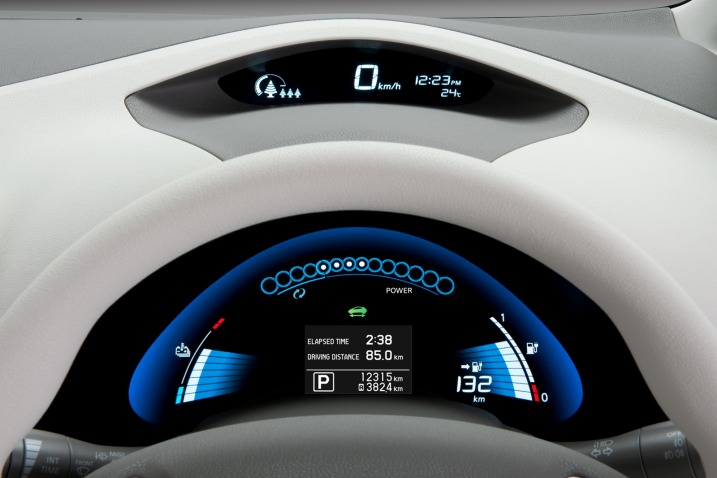
This is a full five-seater with a conspicuously large trunk. You sit a little higher than you might expect because there are 48 lithium-ion battery modules under the floor, but that's no bad thing. The cabin is spacious, airy and promising. The electronic dashboard works particularly well, using state-of-the-art graphics to present almost certainly more information than you will ever need, a way to reassure you that the Leaf is not going to run out of electrons without giving fair warning first. Nissan calls this "range anxiety" and, as we shall see, it's an understandable affliction.
At first, the Leaf is entirely as expected. Once you're satisfied the Leaf is actually awake, you select Drive. Then one small squeeze of the throttle later, you're under way. It's not silent, not quite at least, but even in the unlikely event that your everyday steer is a Rolls-Royce Phantom, you're going to be stunned by the Leaf's smoothness and refinement.

The Fun-To-Drive Quotient
You ease the Leaf through the first corner and see a long straightaway appear, so naturally you nail the throttle to the floor, expecting acceleration of the barely discernible variety. But that's not what you get.

Because maximum torque is always and instantly available, the Leaf jumps forward with sufficient alacrity to make you wonder if it should not be renamed "Leap," a word that describes both its throttle response and game-changing technology with equal precision. Nissan reckons this electric vehicle's midrange punch is on a par with a sedan powered by a 2.5-liter V6 (probably it really means a Nissan Altima 2.5 with its inline-4, but whatever), and we'd not argue with that.

The 2011 Nissan Leaf also has a party piece, a feature quite incidental to the reason it exists but likely to add considerably to its appeal. And that is the location of the batteries under the middle of the car instead of in the trunk. Because the Leaf represents a clean-sheet design, Nissan created a platform that centralizes the weight of its heaviest components — the batteries — within the span of the wheelbase. And this bit of physics when combined with a very low center of gravity makes the Leaf very responsive to directional changes.

That is to say, all this makes the Leaf implausibly good fun to drive. OK, this is no Porsche Cayman, but when your expectations on the dynamic front are precisely zero, anything comes as a pleasant surprise, so the Leaf's ability to corner both flat and fast adds up to considerably more.

Reality Bites
And now we must let the cold light of day flood into this rosy picture. Because while the Nissan Leaf might be surprisingly good to drive, what matters — and what, ultimately, will determine its success or failure — is what it is like to live with.
The bottom line is that currently the 2011 Nissan Leaf has a range of just 100 miles, and that's worked out to the U.S. LA-4 driving cycle (the original EPA city driving cycle, before the current FTP cycle was instituted), and this means that even Nissan admits that the car's owners are going to struggle to achieve it. Moreover, the Leaf will top 90 mph, but it won't travel 100 miles at that sort of speed — 60 miles is more like it, we're told. So this confirms what we all know about electric cars, which is that they are meant for city streets, not interstate freeways.
It's also useful to remember that it takes eight hours to recharge a Leaf with an industrial-type 220-volt hookup, though you can get an 80 percent recharge in 30 minutes from a specialized high-energy recharge station.

The math still adds up for most people, since we live in cities. And, as we're constantly reminded, 80 percent of us cover less than 60 miles daily. So Nissan considers the Leaf to be an eminently viable proposition as a result.

Besides, the Leaf also does much to minimize any residual range anxiety that you might have. Its navigation system is hooked up to a global database, so as the charging infrastructure expands, the nav will automatically update and always be ready to take you to the nearest power supply. Over and above that, the car's operational radius is displayed on the nav screen, so if you program a destination that's beyond the circumference, the nav will not be shy about letting you know.
You can even talk to the 2011 Nissan Leaf through your mobile phone, telling it, for instance, to warm up its interior on a cold morning while it's still parked and charging in your garage, saving you battery life and a cold backside. Once it's charged, it will send you a text saying it's hot to trot.

The Cost of Being Green
Of course what you pay for the electricity and how clean it really is depends on prices that change and the kind of power station in which the electricity was generated, but it's still safe to say that the Nissan Leaf's cost per mile traveled is a small fraction of what it would be for a car of the same size that burns gasoline.

But there's another saving, too. Where a conventional car needs an annual checkup, the Nissan Leaf effectively looks after itself. In fact, Nissan says the only routine maintenance required at the dealer will be the renewal of brake pads, and since the Leaf's regenerative braking system minimizes pad wear, it could be some years before the car needs any maintenance at all.
In around five years, however, the Leaf's lithium-ion batteries will only take around 80 percent of their original charge, so you might feel inclined to change them, not least because the replacements will almost certainly have far greater range than the old ones even when they were new. Indeed Nissan says it has targeted a cruising range of 300-350 miles for the Leaf, though the company admits the technology that will achieve it does not currently exist.

Will This Car Succeed?It's the million-dollar question — or multibillion-dollar question, if you're Nissan. Certainly the 2011 Nissan Leaf will prove an outstandingly able device for delivering urban mobility. The immediacy of its motor response coupled with its unforeseen dynamic nimbleness will make light work of heavy traffic and there really is very little for the range-anxious to fear so long as you remember to put the plug in the wall at night.

But as with other EVs we've driven, the 2011 Nissan Leaf will have to wait for the rest of the world to catch up with it. Only when it's possible to recharge your Leaf with another hundred miles of power in the time it takes to knock back a coffee will this car's true potential be unleashed. And only when batteries are capable of sustaining the Leaf for more than 300 miles or more will this and other EVs stand a chance of prevailing over the conventional automobile with an internal-combustion engine that has served us so well and for so long.

Don't hold your breath waiting for that to happen, though. Even in 2050, up to half the cars on our roads will still be powered by internal-combustion engines, Nissan says. So while the 2011 Nissan Leaf is undoubtedly the start of something big, it seems the finish is so far away that few of us reading this today will even be here to see it.
Source;


, , , , , , , ,

EV News EV News