
Sadly, not for the Canadian market just yet....


One could argue that Honda's reputation is largely based on the various clean air and fuel economy technologies it has promoted over the years. From CVCC to HF to VTEC, NGV to IMA to FCEV, Honda can usually be found tinkering away at or near the top of the mpg charts.
Accordingly, the new 2013 Honda Fit EV looks mighty impressive in terms of EV efficiency. It beats the rival Ford Focus Electric, Mitsubishi i and Nissan Leaf in every consumption and range metric found on a typical EV window sticker, from its low consumption rate of 29 kWh per 100 miles to its stellar combined rating of 118 MPGe to its class-leading range of 82 miles.
But one curious fact stops us in our tracks: You can't buy a 2013 Honda Fit EV. And you may never see one because, all told, Honda expects to produce just 1,100 Fit EVs over the next three years. By contrast, Nissan is close to selling that many Leaf EVs in a month.
What's more, the 2013 Honda Fit EV is a lease-only proposition ($389 per month for 36 months; the tax credit is baked in) that is confined to coastal Southern California, the San Francisco Bay Area, Sacramento and Portland, Oregon. Next spring Honda plans to expand into Boston; New York; Hartford, Connecticut; Baltimore; and Washington, D.C.
A La Mode
The heart of the Fit EV is a permanent magnet electric motor that's rated at 92 kW (123 horsepower). It drives the front wheels through a coaxial single-speed gearbox, in which the differential is bolted directly to one end of the electric motor, not offset in the usual way with drive flanges positioned behind. This works because the motor's main shaft is hollow, allowing the driveshaft that feeds the opposite tire to run straight through the middle.
Full power is only available by pressing a dash-mounted Sport button. The Fit EV's rated efficiency and range comes in Normal mode, the start-up default that produces 75 kW (101 hp). Honda says Sport is 10 percent less efficient than Normal, but a third option, Econ mode, can boost efficiency by 17 percent if you're willing to tolerate 47 kW (63 hp), a deliberately recalcitrant throttle pedal and "optimized" air-conditioning performance.
Moving Out
From rest, Normal and Sport are equally proficient at chirping the Michelin Energy Saver low-rolling-resistance tires thanks to instant-on peak torque. Once under way, Normal feels entirely reasonable for everyday use, even up hills and onto freeway onramps. It's never lightning fast, but there's no problem keeping up.
As expected, the Sport button makes passing and merging easier, and in that mode the Fit EV's power-to-weight ratio is 19 percent better than the Leaf's. We figure 0-60-mph acceleration could register below 9.5 seconds — perhaps a half second better than the Nissan.
There are two shift positions as well: the familiar "D," and a "B" setting that simulates low gear engine braking through the regenerative system. Intended for downgrades, it adds a new dimension of fun in daily use (with no efficiency penalty) à la Mini E, although the effect is less pronounced.
As for the regular brakes, the EV's system of blending electric braking with conventional friction braking produces a firm and consistent pedal that comes across as notably more satisfying than the Leaf.
Battery Pack
Electricity comes from an air-cooled 20 kWh lithium-ion battery pack that's 4 kWh smaller than that of a Leaf. Even so, the Fit EV's range bests the Nissan by 9 miles. Low comparative weight accounts for some of this, as the 3,252-pound Fit EV weighs 123 pounds less than the Nissan.
But the chemistry of the Fit EV's Toshiba-made SCiB (super-charge ion battery) battery modules has more to do with it. Typical lithium-ion battery cells feature a carbon anode, but SCiB cells employ a Lithium Titanate Oxide (LTO) anode instead that can charge and discharge more quickly, allowing the Fit's battery to gobble up and recover energy more readily under braking.
This trait is a boon to plug-in charging, too, and the Fit EV's charging system runs at 6.6 kilowatts instead of the 3.3-kilowatt charge rate of the Leaf. And so it takes 3 hours — less than dinner and a movie — to fully recharge a depleted Fit EV using a standard 240-volt charger. A 7-hour commitment is needed to fill an empty Leaf at the same charging station.
Similar battery technology is found in the 2012 Focus Electric, which can also charge at 6.6 kW. But 372 pounds more Ford leads to a larger 23 kWh battery and 4 hours of 240-volt charge time.
Recharging on 120 volts is less impressive because the typical home garage circuit is the limiting factor. Still, 15 hours is far better than the 21 hours it takes to refill an empty Leaf — different enough to make the need for a 240-volt home charger far less certain.
Adaptation
Significant alterations were needed to slip a battery pack underneath the middle of a Fit. The driver still sits in the same spot, but a recontoured floor positions rear occupants 1.4 inches higher and 3.3 inches farther back. Rear headroom is down, but 37.3 inches of the stuff still feels like a goodly amount. However, fans of the Fit's magic seat will be saddened to learn that it did not survive the reconstructive surgery.
Still more room was needed to keep the battery case from dragging on speed bumps, so the entire body was raised 1.6 inches on its suspension. Taller springs and a new aluminum subframe do the trick up front, but the battery intrudes into space claimed by the Fit's standard-issue twist-beam rear axle. Oh, and there are 675 more pounds to cart around.
As a result, the Honda Fit EV has sprouted a far more sophisticated multilink rear suspension.
The end result is a Fit EV that rides with significantly more smoothness — and quietness — on the broken concrete surfaces and jointed freeways we're driving today. We're talking Accord levels of refinement here.
And the Fit EV is stable when barreling into corners, too, thanks to revised spring and roll stiffness tuning to handle the extra mass. Helping greatly in this regard is a center of gravity that is actually lower because much of the added weight sits below floor level.
Inside
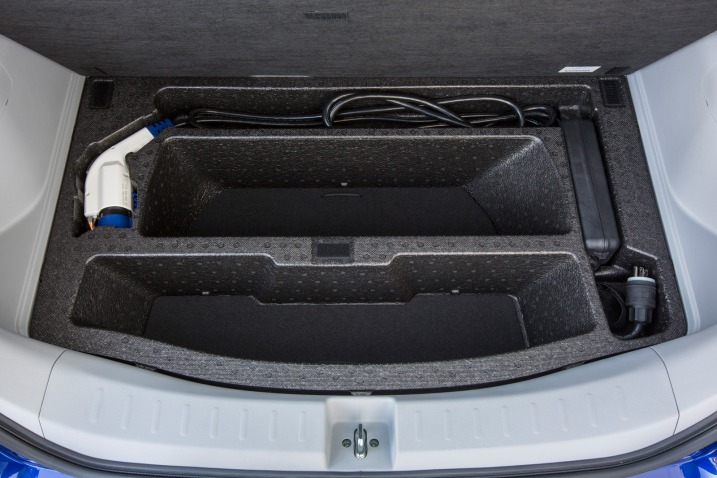
Access to cargo is still good despite the raised body; 25.4 inches of liftover height is still an enviable number. But the rear-shifted seat shrinks rear cargo space from 20.6 to 12 cubic feet. There are 49.4 cubic feet available with the new 60/40 seat folded, but the load floor is no longer flat.
Rear doors that open 80 degrees are still present and they're even more appreciated with the new rear-set seat. The height-adjustable front seat and telescoping wheel still accommodate a wide range of drivers.
A navigation system and back-up camera are standard (there are zero options), and the instrument panel has been reconfigured to provide various types of coaching feedback to help get the most out of each kilowatt-hour of electricity.
A remote on the key fob can initiate a charge, check charge progress, verify cabin temperature and turn on the air-conditioning from 100 feet away. The available HondaLink EV smartphone app does all that and more. It can display available driving range, program an overnight charging session to catch low overnight rates or search for EV charging stations along a route.
Summing Up
The 2013 Honda Fit EV looks class-leading on paper and performs well in person, but that just makes its lease-only status all the more perplexing, even if $389 per month for 36 months seems like a competitive deal. A bit more digging reveals a couple of potential reasons.
Honda says that if it sold the Fit EV it would have to charge $37,415 for it — $2,580 less than a Focus Electric but $1,365 more than a Nissan Leaf. Put it that way and it seems like a ton of dough for a Fit near the end of its life cycle.
As a lease-only proposition with no buyout, Honda's Fit EV battery warranty lasts for "the duration of the lease of the vehicle," which is 3 years or 36,000 miles. Makers of for-sale EVs have to stand behind their batteries far longer, so in theory they can't push them to the max. One wonders if an 8-year/100,000-mile Fit EV battery would perform as well. It seems so, but outside of Honda there's no way of knowing.
Still, if a 3-year lease sounds good to you and you happen to live in one of the designated areas, the 2013 Honda Fit EV is a solid electrified choice. It rides, it handles, it charges quickly and it goes farther on less juice than any of its rivals. Interested? Find out more at Honda's official Fit EV Web site.
Source (with more pix!);
http://www.insideline.com/honda/fit/2013/2013-honda-fit-ev-first-drive.html


Honda Fits the EV Puzzle Pieces Together
One could argue that Honda's reputation is largely based on the various clean air and fuel economy technologies it has promoted over the years. From CVCC to HF to VTEC, NGV to IMA to FCEV, Honda can usually be found tinkering away at or near the top of the mpg charts.
Accordingly, the new 2013 Honda Fit EV looks mighty impressive in terms of EV efficiency. It beats the rival Ford Focus Electric, Mitsubishi i and Nissan Leaf in every consumption and range metric found on a typical EV window sticker, from its low consumption rate of 29 kWh per 100 miles to its stellar combined rating of 118 MPGe to its class-leading range of 82 miles.
But one curious fact stops us in our tracks: You can't buy a 2013 Honda Fit EV. And you may never see one because, all told, Honda expects to produce just 1,100 Fit EVs over the next three years. By contrast, Nissan is close to selling that many Leaf EVs in a month.
What's more, the 2013 Honda Fit EV is a lease-only proposition ($389 per month for 36 months; the tax credit is baked in) that is confined to coastal Southern California, the San Francisco Bay Area, Sacramento and Portland, Oregon. Next spring Honda plans to expand into Boston; New York; Hartford, Connecticut; Baltimore; and Washington, D.C.
A La Mode
The heart of the Fit EV is a permanent magnet electric motor that's rated at 92 kW (123 horsepower). It drives the front wheels through a coaxial single-speed gearbox, in which the differential is bolted directly to one end of the electric motor, not offset in the usual way with drive flanges positioned behind. This works because the motor's main shaft is hollow, allowing the driveshaft that feeds the opposite tire to run straight through the middle.
Full power is only available by pressing a dash-mounted Sport button. The Fit EV's rated efficiency and range comes in Normal mode, the start-up default that produces 75 kW (101 hp). Honda says Sport is 10 percent less efficient than Normal, but a third option, Econ mode, can boost efficiency by 17 percent if you're willing to tolerate 47 kW (63 hp), a deliberately recalcitrant throttle pedal and "optimized" air-conditioning performance.
Moving Out
From rest, Normal and Sport are equally proficient at chirping the Michelin Energy Saver low-rolling-resistance tires thanks to instant-on peak torque. Once under way, Normal feels entirely reasonable for everyday use, even up hills and onto freeway onramps. It's never lightning fast, but there's no problem keeping up.
As expected, the Sport button makes passing and merging easier, and in that mode the Fit EV's power-to-weight ratio is 19 percent better than the Leaf's. We figure 0-60-mph acceleration could register below 9.5 seconds — perhaps a half second better than the Nissan.
There are two shift positions as well: the familiar "D," and a "B" setting that simulates low gear engine braking through the regenerative system. Intended for downgrades, it adds a new dimension of fun in daily use (with no efficiency penalty) à la Mini E, although the effect is less pronounced.
As for the regular brakes, the EV's system of blending electric braking with conventional friction braking produces a firm and consistent pedal that comes across as notably more satisfying than the Leaf.
Battery Pack
Electricity comes from an air-cooled 20 kWh lithium-ion battery pack that's 4 kWh smaller than that of a Leaf. Even so, the Fit EV's range bests the Nissan by 9 miles. Low comparative weight accounts for some of this, as the 3,252-pound Fit EV weighs 123 pounds less than the Nissan.
But the chemistry of the Fit EV's Toshiba-made SCiB (super-charge ion battery) battery modules has more to do with it. Typical lithium-ion battery cells feature a carbon anode, but SCiB cells employ a Lithium Titanate Oxide (LTO) anode instead that can charge and discharge more quickly, allowing the Fit's battery to gobble up and recover energy more readily under braking.
This trait is a boon to plug-in charging, too, and the Fit EV's charging system runs at 6.6 kilowatts instead of the 3.3-kilowatt charge rate of the Leaf. And so it takes 3 hours — less than dinner and a movie — to fully recharge a depleted Fit EV using a standard 240-volt charger. A 7-hour commitment is needed to fill an empty Leaf at the same charging station.
Similar battery technology is found in the 2012 Focus Electric, which can also charge at 6.6 kW. But 372 pounds more Ford leads to a larger 23 kWh battery and 4 hours of 240-volt charge time.
Recharging on 120 volts is less impressive because the typical home garage circuit is the limiting factor. Still, 15 hours is far better than the 21 hours it takes to refill an empty Leaf — different enough to make the need for a 240-volt home charger far less certain.
Adaptation
Significant alterations were needed to slip a battery pack underneath the middle of a Fit. The driver still sits in the same spot, but a recontoured floor positions rear occupants 1.4 inches higher and 3.3 inches farther back. Rear headroom is down, but 37.3 inches of the stuff still feels like a goodly amount. However, fans of the Fit's magic seat will be saddened to learn that it did not survive the reconstructive surgery.
Still more room was needed to keep the battery case from dragging on speed bumps, so the entire body was raised 1.6 inches on its suspension. Taller springs and a new aluminum subframe do the trick up front, but the battery intrudes into space claimed by the Fit's standard-issue twist-beam rear axle. Oh, and there are 675 more pounds to cart around.
As a result, the Honda Fit EV has sprouted a far more sophisticated multilink rear suspension.
The end result is a Fit EV that rides with significantly more smoothness — and quietness — on the broken concrete surfaces and jointed freeways we're driving today. We're talking Accord levels of refinement here.
And the Fit EV is stable when barreling into corners, too, thanks to revised spring and roll stiffness tuning to handle the extra mass. Helping greatly in this regard is a center of gravity that is actually lower because much of the added weight sits below floor level.
Inside
Access to cargo is still good despite the raised body; 25.4 inches of liftover height is still an enviable number. But the rear-shifted seat shrinks rear cargo space from 20.6 to 12 cubic feet. There are 49.4 cubic feet available with the new 60/40 seat folded, but the load floor is no longer flat.
Rear doors that open 80 degrees are still present and they're even more appreciated with the new rear-set seat. The height-adjustable front seat and telescoping wheel still accommodate a wide range of drivers.
A navigation system and back-up camera are standard (there are zero options), and the instrument panel has been reconfigured to provide various types of coaching feedback to help get the most out of each kilowatt-hour of electricity.
A remote on the key fob can initiate a charge, check charge progress, verify cabin temperature and turn on the air-conditioning from 100 feet away. The available HondaLink EV smartphone app does all that and more. It can display available driving range, program an overnight charging session to catch low overnight rates or search for EV charging stations along a route.
Summing Up
The 2013 Honda Fit EV looks class-leading on paper and performs well in person, but that just makes its lease-only status all the more perplexing, even if $389 per month for 36 months seems like a competitive deal. A bit more digging reveals a couple of potential reasons.
Honda says that if it sold the Fit EV it would have to charge $37,415 for it — $2,580 less than a Focus Electric but $1,365 more than a Nissan Leaf. Put it that way and it seems like a ton of dough for a Fit near the end of its life cycle.
As a lease-only proposition with no buyout, Honda's Fit EV battery warranty lasts for "the duration of the lease of the vehicle," which is 3 years or 36,000 miles. Makers of for-sale EVs have to stand behind their batteries far longer, so in theory they can't push them to the max. One wonders if an 8-year/100,000-mile Fit EV battery would perform as well. It seems so, but outside of Honda there's no way of knowing.
Still, if a 3-year lease sounds good to you and you happen to live in one of the designated areas, the 2013 Honda Fit EV is a solid electrified choice. It rides, it handles, it charges quickly and it goes farther on less juice than any of its rivals. Interested? Find out more at Honda's official Fit EV Web site.
Source (with more pix!);
http://www.insideline.com/honda/fit/2013/2013-honda-fit-ev-first-drive.html


