HONDA CRV 2013 AutoCars Honda Civic | Honda Accord, Honda City, Honda Brio, Honda Amaze, Honda odyssey, Honda Assure, Honda Auto Terrace, Honda Customer Jazz, New Honda Cars in United States/America/USA, Canada, United Kingdom, France, Germany, Spain, Italy, India, Japan

Showing posts with label Electric Vehicles. Show all posts

Honda Cars : Electric Honda Fit Hits The Road In CA, Accord Plug-In Hybrid To Follow | 2013 New Honda Car Reviews 0

Unknown | 12:51 PM
Electric Vehicles
Electric Vehicles

Well, that was quick. Just one month after it unveiled the electric Fit EV prototype at the Los Angeles Auto Show, Honda is about to put the first of its electric subcompacts into daily use in southern California.

Amusingly, it's in Torrance, where rival automaker and hybrid leader Toyota has its U.S. headquarters.

The city of Torrance will receive a Honda Fit EV to test early next year, and then in 2012, a Honda Accord sedan fitted with Honda's new plug-in hybrid powertrain as well. Stanford University and Google will also receive their own Fit EV test cars.

In Torrance, the cars will be used by various city departments, including the Economic Development office, the Community Development department, and the Public Works office.

The president and CEO of American Honda Motor Co., Tetsuo Iwamura, took part in a ceremony with Torrance mayor Frank Scotto to hand over a symbolic Honda key. Honda's demonstration program will give the company real-world data on how drivers use both electric and plug-in hybrid vehicles.

The all-electric Honda Fit EV will be launched in 2012 in the U.S. and Japan, probably as a 2013 model. Its lithium-ion battery pack gives it a range of up to 100 miles (70 miles when applying EPA's adjustment factor), and Honda quotes a top speed of 90 miles per hour.

Source;
http://www.greencarreports.com/blog/1052617_electric-honda-fit-hits-the-road-in-ca-accord-plug-in-hybrid-to-follow


, , , , , ,

Honda Cars : Det News: Groundbreaking Chevy Volt is buzzworthy | 2013 New Honda Car Reviews 0

Unknown | 7:20 AM
Electric Vehicles
Electric Vehicles

Here's a really good article on the Chevy Volt....
By Scott Burgess

No one can screw up a good thing like General Motors Co., the U.S. carmaker with the innate ability to magically unravel silk purses into a sow's ear faster than a website can post an outlandish headline.

Sadly, as editors and reporters around the world attempt to understand planetary gear sets (hint, the sun gear is in the middle), half shafts and high-speed generator motors, the 2011 Chevrolet Volt will get parked in a confused haze of what percentage of torque from the gas engine turns the wheels.

Here's my take: I don't care.

Instead of trapping GM in a lie or defending a company that should have seen these storm clouds three years ago, I'll simply add my 2 cents: The Volt is a great car.

Label mongers who demand the Volt is a hybrid (it's not) can slap a hybrid refrigerator magnet on the fender if they want. They should also admit, according to their own standards, that the Volt is the best hybrid on the face of the Earth. Then, go out and buy two.

Electric purists who say the Volt is an electric car (it's not) must also admit that all electric cars are currently coal-fired, steam-powered vehicles, which is where most of our juice comes from nowadays. Then, go out and buy two.

It's important that anyone vocal enough to e-mail me their insightful and uninformed thoughts buy at least two Chevy Volts to help lower its price. With a starting sticker of $41,000, the Volt might as well run on diamonds, which used to be coal before succumbing to untold tons of (media) pressure.

No matter how you view this gem of GM, the Volt delivers electric car performance and unlimited gas mileage if you drive like 80 percent of America, less than 40 miles a day.

The problem with the Volt is the technology under the hood is more complicated than a five-word headline.

We live in a world that requires definitive labels. Something this new represents change, and lots of people find change scary.

Powered upThe Volt will leave you screaming, but from its performance and great acceleration.
The electric motors produce 149 horsepower and 273 pound-feet of torque. Those are torque numbers you see in V-6s. There are three driver settings: normal, sport and mountain, which adjust a number of electric inputs. My favorite is sport.

The electric power steering is clean, well-weighted and provides a nice return to center. The suspension, which includes an independent front and semi-independent torsion beam rear, is soft for this heavy car. GM has not released its weight, though with more than 400 pounds of batteries, two electric motors and a small four-cylinder gas engine, this car won't be light. Its body rolling through hard corners and tight maneuvering was kind of expected.

The brakes, which include regenerative braking to help push more electricity into the battery pack, take a little getting used to.

The Volt provides a drive setting that will force harder regen braking, similar to some hybrids, and it feels like the car has downshifted when the driver takes his foot off the accelerator. While eco-fficient, it's also eco-nnoying.

Perhaps the most impressive part of the Volt ride is how quiet it is. When the gas engine kicks on, it purrs. The start/stop system on the gas engine is flawless, making it difficult to tell when exactly the engine has turned over. There were more than a couple of times while driving it that I had to roll down the window to confirm whether the engine was on or off.

Chevrolet accomplished this with a number of lightweight sound-dampening materials, some of which were sprayed onto body panels, and a laminated windshield. Add to that a car with a drag coefficient of 0.28 and you understand why it's so quiet.

Inside beauty
The cabin is simply the best Chevy interior available. The two-tone dash clearly marks the traditional dual cockpit design that moves from the dash through the doors in a nearly seamless look. This helps the cabin feel even bigger. The grains and materials are all top notch throughout.
The optional heated leather seats are a must order — though interestingly, they are not electric powered. The leather just looks and feels nicer than cloth seats. While there are only two seats in the second row (instead of the bench seat) because of the battery package, I prefer this approach. Most compacts technically can sit five people, but rarely five adults.

The 7-inch LCD digital instrument panel adds to the car's high-tech feel, as does the 7-inch touch screen at the top of the dash. Both are programmable and can be adjusted to show a multitude of settings. Throughout the cabin, the driver is always reminded of the car's eco sensibilities.

The white center stack in my test vehicle added a clean and Apple-esque feel to the interior and the buttonless center stack, which uses touch sensitive spots, are easy to use and add to the clean feel. This is the most thoughtful design and best executed interior Chevy has ever created.

Worth the money?
All of this technology comes with a price: $41,000 or $33,500 after the government rebate. Is it worth it?

If you're looking for some sort of pay back, such as the money saved driving electric, then the answer is no. It may offer every bell and whistle from push button start to a smart phone app that can monitor the car, but it will never save you the difference.

But electric cars are more than an economical purchase. For people who want to drive an electric car without the hassle of range limits and for people who want to buy a car with cutting-edge technology, the answer is a resounding yes.

For the money, here's what you get: An electric car for the first 40-something miles — Chevy states the range as 25 miles to 50 miles, depending upon the weight of the driver's foot.

During two days of testing, I managed 32 miles on electric only at better-than-highway speeds.

The following day, with more typical driving, I managed 46 battery miles.

That means I could drive to work and back and never use a drop of gasoline. The next day, I could do the same thing. No gasoline car or traditional hybrid can make the same claim.

Then over the weekend, I could drive to Knoxville, Tenn., and back with never a worry and never a recharge. No electric car in the world can make that claim.

Introducing an all-new vehicle, something that has never been tried or sold before, takes money and gumption. Chevrolet has shown both.

The Volt is world-beater. Mother Nature might be the first to buy two.

Source;
http://detnews.com/article/20101014/OPINION03/10140368/1148/auto01/Groundbreaking-Chevy-Volt-is-buzzworthy


, , , , , ,

Honda Cars : How Fast Can You Really Charge Your Plug-in Car? | 2013 New Honda Car Reviews 0

Unknown | 7:15 AM
Electric Vehicles
Electric Vehicles

Here's a pretty interesting read and puts a little more perspective on why Honda hasn't aggressively pursued this avenue....
By Nick Chambers

Tue Aug 31, 2010 12:28am EDT
We are quickly approaching the launch dates of the Nissan LEAF and Chevrolet Volt-the first two globally-distributed and mass-market plug-in cars the world has ever seen. Beyond those two groundbreaking vehicles, every major automaker has now committed to delivering some sort of plug-in vehicle within the next five years. As the public's attention shifts to the battery-powered drivetrain and its perceived shortcomings, the question of how long it will take to charge the battery has rightly taken center stage.
To this point, much of the conversation regarding plug-in car charging times has revolved around what kind of charging station you use. In the US, as many of us know, there are essentially three types of charging:

A standard 3-prong household outlet, also known as "Level 1 charging"A specialized home charging station, also known as "Level 2 charging"A commercial quick charging station, known alternately as both "DC fast charging" and "Level 3 charging."Listening to radio and TV shows, and reading through internet threads devoted to the topic of "How long will it take me to charge my electric car," it is apparent that there is a very big information gap out there when it come to charging times and what you might reasonably expect for your Nissan LEAF or Chevy Volt or Coda Sedan or whatever other electric car come down the pipe.
For the rest of the article, follow the link below;


, , , , , ,

Honda Cars : 2011 Nissan Leaf First Drive | 2013 New Honda Car Reviews 0

Unknown | 6:45 AM
Electric Vehicles
Electric Vehicles

I am interested to see how this does, it looks like a great start in the 'alternative fuel' race....
If Fortune Favors the Brave, This Car Deserves To Succeed
Given that there has been so much talk and so many wise words from so many different directions about our all-electric future, it can almost go unnoticed that the one thing no one has actually gotten around to doing is translating a single syllable into something a normal family with a normal budget can go out and buy.

Until now.

The 2011 Nissan Leaf is not a low-volume slice of automotive exotica like a Tesla Roadster, nor is it an electrified version of a conventional gasoline car like the Mitsubishi i MiEV, and it is certainly not a plug-in hybrid like a Chevrolet Volt or a conventional hybrid like a Toyota Prius. The 2011 Nissan Leaf is a brand-new, purpose-built, mass-produced, battery-powered family car and, as such, the very first of its kind in the world. And we've driven it.
But is it a real car for real people?

You Say You Want a Revolution
The moment of truth is upon us. We're in the East End of London in a large concrete parking lot upon which Nissan has marked out a track for us to sample the 2011 Nissan Leaf. Actually, two Leafs are here today. One is for static assessment, and it cannot be driven. The car that can be driven is a late-series prototype, and this one wears the body of a Nissan Tiida, known as the Versa in the U.S. Underneath the bodywork, however, this car is pure Leaf. It is very like the car that John O'Dell, editor of Edmunds.com's Green Car Advisor, drove last summer.

Before you even slot the shift lever into Drive and tentatively press the throttle, the 2011 Nissan Leaf has done much to win you over. For a start, there's no reason not to have one — in design terms, anyway.

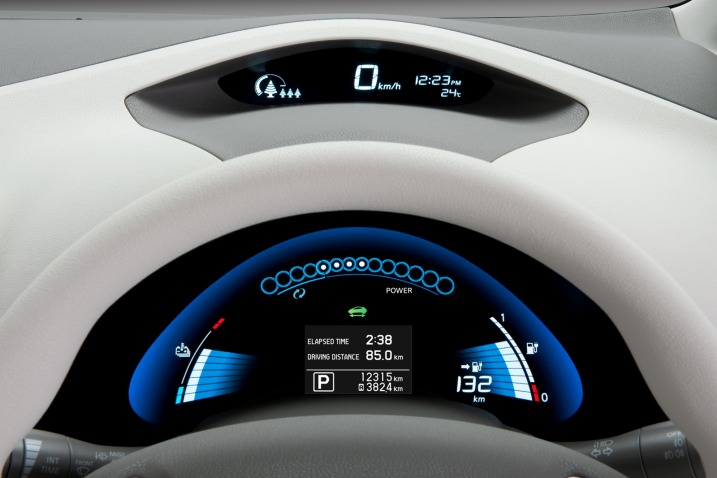
This is a full five-seater with a conspicuously large trunk. You sit a little higher than you might expect because there are 48 lithium-ion battery modules under the floor, but that's no bad thing. The cabin is spacious, airy and promising. The electronic dashboard works particularly well, using state-of-the-art graphics to present almost certainly more information than you will ever need, a way to reassure you that the Leaf is not going to run out of electrons without giving fair warning first. Nissan calls this "range anxiety" and, as we shall see, it's an understandable affliction.
At first, the Leaf is entirely as expected. Once you're satisfied the Leaf is actually awake, you select Drive. Then one small squeeze of the throttle later, you're under way. It's not silent, not quite at least, but even in the unlikely event that your everyday steer is a Rolls-Royce Phantom, you're going to be stunned by the Leaf's smoothness and refinement.

The Fun-To-Drive Quotient
You ease the Leaf through the first corner and see a long straightaway appear, so naturally you nail the throttle to the floor, expecting acceleration of the barely discernible variety. But that's not what you get.

Because maximum torque is always and instantly available, the Leaf jumps forward with sufficient alacrity to make you wonder if it should not be renamed "Leap," a word that describes both its throttle response and game-changing technology with equal precision. Nissan reckons this electric vehicle's midrange punch is on a par with a sedan powered by a 2.5-liter V6 (probably it really means a Nissan Altima 2.5 with its inline-4, but whatever), and we'd not argue with that.

The 2011 Nissan Leaf also has a party piece, a feature quite incidental to the reason it exists but likely to add considerably to its appeal. And that is the location of the batteries under the middle of the car instead of in the trunk. Because the Leaf represents a clean-sheet design, Nissan created a platform that centralizes the weight of its heaviest components — the batteries — within the span of the wheelbase. And this bit of physics when combined with a very low center of gravity makes the Leaf very responsive to directional changes.

That is to say, all this makes the Leaf implausibly good fun to drive. OK, this is no Porsche Cayman, but when your expectations on the dynamic front are precisely zero, anything comes as a pleasant surprise, so the Leaf's ability to corner both flat and fast adds up to considerably more.

Reality Bites
And now we must let the cold light of day flood into this rosy picture. Because while the Nissan Leaf might be surprisingly good to drive, what matters — and what, ultimately, will determine its success or failure — is what it is like to live with.
The bottom line is that currently the 2011 Nissan Leaf has a range of just 100 miles, and that's worked out to the U.S. LA-4 driving cycle (the original EPA city driving cycle, before the current FTP cycle was instituted), and this means that even Nissan admits that the car's owners are going to struggle to achieve it. Moreover, the Leaf will top 90 mph, but it won't travel 100 miles at that sort of speed — 60 miles is more like it, we're told. So this confirms what we all know about electric cars, which is that they are meant for city streets, not interstate freeways.
It's also useful to remember that it takes eight hours to recharge a Leaf with an industrial-type 220-volt hookup, though you can get an 80 percent recharge in 30 minutes from a specialized high-energy recharge station.

The math still adds up for most people, since we live in cities. And, as we're constantly reminded, 80 percent of us cover less than 60 miles daily. So Nissan considers the Leaf to be an eminently viable proposition as a result.

Besides, the Leaf also does much to minimize any residual range anxiety that you might have. Its navigation system is hooked up to a global database, so as the charging infrastructure expands, the nav will automatically update and always be ready to take you to the nearest power supply. Over and above that, the car's operational radius is displayed on the nav screen, so if you program a destination that's beyond the circumference, the nav will not be shy about letting you know.
You can even talk to the 2011 Nissan Leaf through your mobile phone, telling it, for instance, to warm up its interior on a cold morning while it's still parked and charging in your garage, saving you battery life and a cold backside. Once it's charged, it will send you a text saying it's hot to trot.

The Cost of Being Green
Of course what you pay for the electricity and how clean it really is depends on prices that change and the kind of power station in which the electricity was generated, but it's still safe to say that the Nissan Leaf's cost per mile traveled is a small fraction of what it would be for a car of the same size that burns gasoline.

But there's another saving, too. Where a conventional car needs an annual checkup, the Nissan Leaf effectively looks after itself. In fact, Nissan says the only routine maintenance required at the dealer will be the renewal of brake pads, and since the Leaf's regenerative braking system minimizes pad wear, it could be some years before the car needs any maintenance at all.
In around five years, however, the Leaf's lithium-ion batteries will only take around 80 percent of their original charge, so you might feel inclined to change them, not least because the replacements will almost certainly have far greater range than the old ones even when they were new. Indeed Nissan says it has targeted a cruising range of 300-350 miles for the Leaf, though the company admits the technology that will achieve it does not currently exist.

Will This Car Succeed?It's the million-dollar question — or multibillion-dollar question, if you're Nissan. Certainly the 2011 Nissan Leaf will prove an outstandingly able device for delivering urban mobility. The immediacy of its motor response coupled with its unforeseen dynamic nimbleness will make light work of heavy traffic and there really is very little for the range-anxious to fear so long as you remember to put the plug in the wall at night.

But as with other EVs we've driven, the 2011 Nissan Leaf will have to wait for the rest of the world to catch up with it. Only when it's possible to recharge your Leaf with another hundred miles of power in the time it takes to knock back a coffee will this car's true potential be unleashed. And only when batteries are capable of sustaining the Leaf for more than 300 miles or more will this and other EVs stand a chance of prevailing over the conventional automobile with an internal-combustion engine that has served us so well and for so long.

Don't hold your breath waiting for that to happen, though. Even in 2050, up to half the cars on our roads will still be powered by internal-combustion engines, Nissan says. So while the 2011 Nissan Leaf is undoubtedly the start of something big, it seems the finish is so far away that few of us reading this today will even be here to see it.
Source;


, , , , , , , ,

Honda Cars : Do YOU Know All About Electric Vehicles OR Do YOU Just Know The Myths? | 2013 New Honda Car Reviews 0

Unknown | 7:50 AM
Electric Vehicles
Electric Vehicles

Here's a good read....
Soon enough it seems that all that will be available to drive will be electric vehicles. With governments across the globe embracing electric vehicles, and pushing for innovation and product development, the days of the gasoline-powered automobile look numbered.

But, are EVs so bad?

According to Plug In America, they are not. Granted, they may be slightly biased.Take a look below and scan through the top 12 myths about EVs. Do YOU think these myths are fact or fiction?

Let us know, SPIES!

Press release follows:

Plug In America, a nonprofit group leading the clean-vehicle movement, is issuing the following list of common misconceptions or “myths” about all-electric and plug-in hybrid electric cars. Media and others continue to misunderstand and mischaracterize this new technology. Thousands of these clean vehicles—many of them zero-emission—are expected to start coming to auto dealerships in late 2010. See Plug In America’s Tracker for a comprehensive list of such vehicles on the road today and expected for delivery in 2010 and beyond.

Acronyms and definitions:
· EV: Electric Vehicle, meaning all-electric (no gas)
· BEV: Battery Electric Vehicle or all-electric vehicle
· PHEV: Plug-in Hybrid Electric Vehicle
· Plug-in or Plug-in electric vehicle: Either a BEV or a PHEV

Number of EVs Driven Today:

Plug In America estimates that there are 3,000 highway-capable EVs from major automakers on U.S. roads today:

· 800 Toyota RAV4-EVs
· 1,000 Teslas
· 150 Ford Ranger trucks
· 50 Chevy S-10 trucks
· 500 test-only BMW Mini Es
· 500 others including Solectrias and EPIC Mini-Vans

MYTH: EVs don't have enough range. You'll be stranded when you run out of electricity
FACT: Americans drive an average of 40 miles per day, according to the U.S. Dept. of Transportation. Most new BEVs have a range of at least double that and can be charged at any ordinary electrical outlet (120V) or publicly accessible station with a faster charger. The latter, already in use, will proliferate as the plug-in infrastructure is built out. At present, all it takes is planning for EV owners, who can travel up to 120 miles on a single charge, to use their cars on heavy travel days. Alternatively, a PHEV goes at least 300 miles on a combination of electricity and gasoline.

Myth: EVs are good for short city trips only
FACT: Consumers have owned and driven EVs for seven years or more and regularly use them for trips of up to 120 miles.

MYTH: EVs just replace the tailpipe with a smokestack
FACT: Even today, with 52% of U.S. electricity generated by coal-fired power plants, plug-in cars reduce emissions of greenhouse gases and most other pollutants compared with conventional gas or hybrid vehicles. Plug-ins can run on renewable electricity from sources such as the sun or wind. PHEVs will reduce greenhouse gases and other emissions, even if the source of electricity is mostly coal, a 2007 study by the Electric Power Research Institute (EPRI) and NRDC showed. Read the summary of some 30 studies, analyses and presentations on this topic.

MYTH: The charging infrastructure must be built before people will adopt EVs
FACT: Most charging will be done at home, so a public charging infrastructure isn’t a prerequisite. Still, a robust infrastructure will help, especially for apartment dwellers and those regularly driving long distances. But at least seven companies are competing to dominate the public-charging-station market and a trade group representing the nation's electric utilities has pledged to “aggressively” create the infrastructure to support “full-scale commercialization and deployment” of plug-ins.

MYTH: The grid will crash if millions of plug-ins charge at once
FACT: Off-peak electricity production and transmission capacity could fuel the daily commutes of 73% percent of all cars, light trucks, SUVs and vans on the road today if they were PHEVs, a 2007 study by Pacific Northwest National Laboratory found. Also, utilities are upgrading some local distribution systems to accommodate plug-ins, just as they do when residents add more air conditioners and TVs. Plug-ins, which can be seen as energy storage devices on wheels, can actually benefit the grid, making green energies like solar and wind power even more viable.

MYTH: Battery chemicals are bad for the environment and can't be recycled
FACT: Ninety-nine percent of batteries in conventional cars are recycled, according to the U.S. Environmental Protection Agency. The metals in newer batteries are more valuable and recycling programs are already being developed for them. Utilities plan to use batteries for energy storage once they are no longer viable in a vehicle.

MYTH: EVs take too long to charge
FACT: The most convenient place and time to charge is at home while you sleep. Even using the slowest 120-volt outlet, the car can be left to charge overnight, producing about 40 miles of range. Most new BEVs and PHEVs will charge from 240-volt outlets providing double or triple the charge in the same amount of time. Charging stations that reduce charging time even more are beginning to appear.

MYTH: Plug-ins are too expensive for market penetration
FACT: New technologies are typically costly. Remember when cell phones and DVDs were introduced? Also, the government stimulus package includes a $2,500 to $7,500 tax credit for EVs and PHEVs. Some states are considering additional incentives ($5,000 in California and Texas). And, the purchase and lifetime operating cost of an EV is on par with or less than its gas-powered equivalent because EVs require almost no maintenance or repair: no oil or filter changes, no tune ups, no smog checks.

MYTH: Batteries will cost $15,000 to replace after only a few years
FACT: The battery is the priciest part of a plug-in, but costs will drop as production increases and the auto industry is expected to be purchasing up to $25 billion in advanced batteries annually by 2015. Some car makers plan to lease their batteries, so replacement won’t be an issue. The Chevy Volt PHEV will have a 10-year battery warranty that would cover battery replacement.

MYTH: There isn't enough lithium in the world to make all the new batteries
FACT: Even in a worst-case scenario of zero battery recycling, aggressive EV sales, no new mining methods or sites, existing lithium stores will be sufficient for projected EV production for the next 75 years. See an analysis at PlugInAmerica.org. Also, lithium comes from many countries (24% is found in the United States), so we won’t be dependent on any one global region.

MYTH: Lithium batteries are dangerous and can explode
FACT: Among the many kinds of lithium-ion batteries, lithium-cobalt batteries found in consumer electronics can pose a fire risk in certain circumstances. These risks can be mitigated by the use of advanced-battery management systems and careful design that prevents “thermal runaway.” Most plug-in vehicle makers are working with other battery types (such as lithium-iron-phosphate and lithium-manganese) which have inherent safety advantages and provide more years of service.

MYTH: Most of us will still be driving gas cars through 2050
FACT: Several irrefutable factors are driving the shift from gasoline to plug-in vehicles: ever-toughening federal fuel economy standards and state caps on greenhouse gas emissions; projected price hikes for petroleum products as demand increases and supply flattens or drops; broad agreement over the need for America to reduce its reliance on petroleum for economic and national security reasons; and climate change, which is occurring faster than previously thought, according to the journal Science and many other sources.

Source;
http://www.autospies.com/news/Do-YOU-Know-All-About-Electric-Vehicles-OR-Do-YOU-Just-Know-The-Myths-50647/


, , , , , , ,

Electric Vehicles Electric Vehicles