HONDA CRV 2013 AutoCars Honda Civic | Honda Accord, Honda City, Honda Brio, Honda Amaze, Honda odyssey, Honda Assure, Honda Auto Terrace, Honda Customer Jazz, New Honda Cars in United States/America/USA, Canada, United Kingdom, France, Germany, Spain, Italy, India, Japan

Showing posts with label Green Cars. Show all posts

Honda Cars : Japanese car maker steps up efforts to reduce carbon footprint | 2013 New Honda Car Reviews 0

Unknown | 8:28 AM
Green Cars
Green Cars

There are more ways than just making enviro cars to be environmentally friendly....
By Abigail L. Ho
Philippine Daily Inquirer

MANILA, Philippines—Recognizing that vehicles are big contributors to pollution, Honda Cars Philippines Inc. is stepping up efforts to reduce its own carbon footprint by implementing various environment-saving measures in its Sta. Rosa, Laguna manufacturing facility.

In a speech during the celebration of the company's 20th anniversary, Honda Philippines president and general manager Hiroshi Shimizu said that from 2006, the car manufacturer had slashed carbon emissions from its production activities by as much as 20 percent.

This was achieved through the implementation of energy demand side management activities, as well as energy efficiency and conservation measures, including the conduct of energy audits
and the installation of energy-efficient equipment and lighting systems.

Shimizu related that the company has also embarked on a waste reduction program that aimed to eliminate manufacturing-related wastes by next year.

Efforts directed at achieving this goal included the reduction and segregation of various waste products, the use of recyclable packaging for the parts that it exports, and the treatment of its hazardous waste materials through cement kiln technology.

Honda Motor Co., the car maker's Japanese parent, is constantly conducting research on automotive technologies that will reduce carbon emissions.

Michio Shinohara, general manager of Honda's environment and safety planning office, said the company was working hard to accelerate the rollout of vehicle models using electromotive technologies.

"The shift to electromotive technologies is one of the most effective ways to reduce carbon emissions,'' he said.

Honda earlier in the year launched a real-world demonstration program of its electric motorcycles and automobiles, in cooperation with Japan's Kumamoto and Saitama prefectures.

These personal mobility products, powered by electromotive technology, were used in a mainstream urban setting to determine the effectiveness of such vehicles under normal driving conditions and to study how the future urban transportation system should be designed to provide the most improvement to overall quality of life.

Honda also sells hybrid vehicles in other markets, but is not inclined to do so until after 2013, when the tariff on such vehicles go down to zero under the Japan-Philippines Economic Partnership Agreement.

Source;
http://business.inquirer.net/money/topstories/view/20101024-299535/Japanese-car-maker-steps-up-efforts-to-reduce-carbon-footprint


, , , , , , , ,

Honda Cars : Honda Accord Hybrid V2.0: Honda Preparing to Resurrect the Accord Hybrid | 2013 New Honda Car Reviews 0

Unknown | 7:04 AM
Green Cars
Green Cars

I always thought that the Accord Hybrid was a nice car, just it had to be a 4cyl, people buying hybrids are after the fuel economy, not so much performance....
In 2004, Honda released its third hybrid, a gas-electric version of the Accord EX V6 sedan. The car represented a new spin on hybrid powertrains, with the carmaker opting to use supplemental power from the vehicle's battery to enhance performance rather than maximize fuel efficiency.

Where the obvious move would have been to attach its hybrid system to the four-cylinder Accord model—potentially boosting fuel economy from a pedestrian 24 mpg combined rating into the range of other best-in-class mid-size offerings—Honda instead chose to pair the system with a V6 and configure that pairing to provide an additional 15 horsepower to the Accord EX V6's already meaty 240 hp. Fuel efficiency for the vehicle languished at a paltry 25 mpg city, 34 mpg highway rating—with the combined number coming in just 1 MPG higher than the base model Accord.

Consumers were not impressed. Honda sold less than 6,000 Accord hybrids in 2006 and less than a year later, the car was canceled. "Hybrid manufacturers have largely been unable to expand the public's perception of hybrids beyond high fuel economy," said Kelley Blue Book's Jack Nerad at the time.

Now comes word from Automotive News that Honda is once again preparing a hybrid version of the Accord. Will the carmaker aim to bring big efficiency gains to the vehicle's 24/31 fuel economy rating, or has it decided that the market is finally ready for a hybrid that boosts power at the expense of substantive fuel economy gains?

With gas prices low, and Toyota recently deciding to go in a similar direction with its new Highlander hybrid SUV, it's possible that performance-oriented hybrids could be making a comeback. But with Honda's green vehicle lineup struggling and the carmaker's own president complaining that company had become "complacent" about new technology in recent years, it's difficult to see how an extra 15 horsepower and 1-2 MPGs could bring Honda back to prominence as a maker of fuel-efficient vehicles.

For now, all that's known is that a new gas-electric Accord is on its way, so we'll have to save our judgments for when more details are available. Hopefully, Honda will be a little more bold with its hybrid this time around.

Source (via autoblog);
http://www.hybridcars.com/news/honda-preparing-resurrect-accord-hybrid-28644.html


, , , , , , ,

Honda Cars : 2010 Paris Auto Show: HONDA JAZZ HYBRID - LOW EMISSIONS AND PRACTICALITY WITHOUT COMPROMISE | 2013 New Honda Car Reviews 0

Unknown | 6:47 AM
Green Cars
Green Cars

Not for North America yet....
The Jazz Hybrid is making its world motor show debut at the 2010 Paris Motor Show, further demonstrating Honda's continuing commitment to petrol-electric hybrid technology.

The launch of the latest addition to the practical Jazz line-up marks the first time a parallel hybrid vehicle has been available to B-segment consumers. Importantly the Jazz Hybrid will not lose any of its practicality, with the compact nature of the Honda IMA system allowing the B-segment car to retain its ultra-flexible "Magic Seats" and 300 litres of boot space.

The IMA battery pack and power control unit have been integrated in the area under the boot floor, retaining the normal boot area and allowing the "Magic Seats" to fold in the same manner as non-hybrid versions. This means that the seats still fold entirely flat to provide a surprising 831 litre of space or the seat bases can be folded up to sit vertically, so as to accommodate tall items within the car.

The IMA hybrid system is shared with the Insight and CR-Z hybrids, taking advantage of the proven reliability of this important technology. With almost two decades of development and 10 years of sales behind it, the Honda IMA system has proven itself to be a flexible and dependable system, with over half a million vehicles on the road benefitting from its combination of low emissions and fuel economy.

The new model features the same IMA system as in the Insight hybrid, using the same 1.3 litre i-VTEC engine as its dedicated hybrid model sibling. The IMA system is combined with a CVT gearbox in the Jazz and with emissions of just 104 g/km* of CO2 it has the lowest CO2 output of any automatic car in the B-segment. As a petrol-electric hybrid, the new derivative has ultra-low levels of other exhaust emissions, not just taxable elements. Visually the Jazz Hybrid is distinguished from the current Jazz range with revised headlights, which have a blue surround, clear rear lights, new front grille, restyled bumpers and a chrome tailgate garnish. The new hybrid will be available in a range of existing colours plus a bespoke Lime Green metallic.

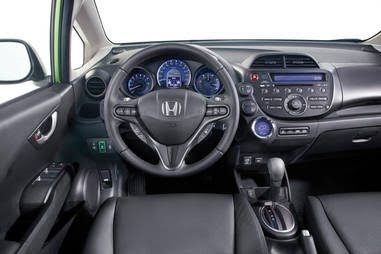
Inside the cabin is given a fresh look with a darker single colour dashboard, which contrasts strongly with the blue lighting of the dials and centre console. The new hybrid is also available with leather trim, the first time this has been available on a Jazz model in Europe. The dashboard integrates a version of the Eco Assist function, which uses the ambient lighting of the speedometer to advise the driver on how their driving style is impacting on their fuel economy.

The Eco Assist function aides drivers in getting the maximum economy from their car in everyday situations and gives users real-time feedback on how their use of the brakes and throttle affects their fuel bills and environmental impact.

*Internal figure, homologation not yet finalised

While respecting the unique features of the car, a range of Genuine Accessories will accentuate its hybrid character even further. Decoration items, such as doorstep garnishes, a variety of exterior and interior stickers, B-pillar garnishes and alloy wheels can be fitted according to the driver's personal taste. A Solid State Drive navigation, hands-free Bluetooth® and rear entertainment system are set to provide extra technological comfort. A complete range of Genuine Accessories is available for those customers that want to add in even more functionality and style.

The Jazz Hybrid will go on sale in some European markets in the early part of 2011, prices and full specifications will be announced in due course.

Source;
http://www.hondanews.eu/en/news/index.pmode/modul,detail,0,1585-DEFAULT,21,text,1/index.pmode


, , , , , , , , ,

Honda Cars : Honda Confirms Next-Gen Civic GX Natural Gas Vehicle | 2013 New Honda Car Reviews 0

Unknown | 7:44 AM
Green Cars
Green Cars

by Brian Moody

In Translogic episode 6.2 we took a look at one of the cleanest yet most obscure green cars sold in the U.S., the 2011 Honda Civic GX. The GX is just like every other Civic, except that its engine burns compressed natural gas (CNG) rather than gasoline.

Honda confirmed to Translogic that when the company redesigns the Civic for its ninth generation, there will be a Honda Civic GX. Since the GX sells in such small numbers, there was speculation that it might be dropped when Honda undertakes a complete overhaul of the Civic, as it has scheduled for the 2012 model year. But Honda is dedicated to the CNG Civic and says hopes to make it a bigger part of their alt-fuel efforts.
Ever since the car's introduction in 1998, the Civic GX has really been more of a fleet car rather than typical retail car the average shopper would consider. In 2009, Honda sold just 1,757 Civic GX's.
The car's fleet origins mean the interior is a little lackluster. It's no secret, Honda already knows the Civic GX lacks the bells and whistles even sub-compact owners have come to expect. Jessica Fini with American Honda said "Due to customer feedback, the 2012 Honda Civic GX NGV will be more comfortable and offered with desirable options like a navigation system and upgraded stereo." Perhaps the secret of the Civic GX is about to get out.
Honda also confirmed that the 2012 Honda Civic GX will not deviate from the current car's basic formula of being a Honda Civic first and foremost and a NGV second. The Formula seems to be working; the 2010 Civic GX was named "Greenest Vehicle" by the American Council for an Energy Efficient Economy.
But the picture isn't all rosy for the natural gas powered Civic, a lack of public CNG fueling stations could put a damper on Civic GX ownership. For instance, according to cngprices.com, there are just two CNG refueling stations in the Atlanta area and one requires special key-card for access and there's just one CNG station between Miami and Jacksonville. On the other hand, cities like Boston, Denver, New York, Salt Lake City and Tulsa, Oklahoma have many CNG stations. California seems to have the most CNG stations of any other state: San Francisco, Sacramento and Los Angeles combined probably have more re-fueling stations than the entire rest of the country. Even so, some CNG stations in the Los Angeles area are 10-20 miles away from the center of many suburban communities. There is a reward once you find a station, many people are paying the equivalent of $1.07-$2.60 per gallon.
Some Civic GX owners can capitalize on the low price of CNG and skip the infrastructure worries by outfitting their homes with a refueling mechanism that uses the natural gas already piped to most homes. The cost is about $4,600 but you can get a tax credit of $2,000. The company that made the Phill refueling unit was purchased by another company so it's unclear if an individual in every state can still get a natural gas compressor installed at home. Gas Equipment Systems Inc has offices in California and Texas so that's a good place to start
Honda says the Civic GX is the cleanest burning internal combustion engine in the world. But for every advantage with the CNG powered Civic, there seems to be a disadvantage. The Civic GX isn't especially thrilling to drive; with its 1.8 liter engine making just 113 hp, the car feels slower than a regular Civic. A gasoline powered Civic with a 1.8 liter engine makes 140 hp – a difference that's noticeable to the average driver. Also, the Honda Civic GX costs a little more than $25,000. By comparison, a Honda Civic EX with leather and navigation is still about $2,000 less. And the Civic EX cruises to a combined EPA estimate of 29 mpg. The equivalent combined fuel economy estimate for the Civic GX is 28 mpg. Those who buy a new 2010 Honda Civic GX may qualify for a $4,000 tax credit and Californians who buy a new Civic GX will qualify for the states zero emission HOV stickers which means you can use the carpool lane even if you're alone in the car.
In the end, the Honda Civic GX's green credential are rock solid, what's not so clear is if the car makes sense for the average green leaning motorist. Honda already has a Civic Hybrid, Insight Hybrid and the sporty CR-Z Hybrid plus the gasoline powered Honda Fit gets a respectable 36 miles per gallon on the highway. The difference is all of Honda's fuel sippers can be fueled up at the local filling station while the Civic GX can't and that's really the car's Achilles heel.
Source;


, , , , , , , , ,

Honda Cars : EPA reveals top 10 most fuel-efficient cars since 1984, original Honda Insight takes top honors | 2013 New Honda Car Reviews 0

Unknown | 9:33 AM
Green Cars
Green Cars

Best overall REAL WORLD Gas mileage vehicles since 1984....
Best Overall EPA Rated Gas Mileage vehicles since 1984....
Fuel efficiency has increased dramatically in the last decade, or at least that's what we've been told. So it might come as a surprise to find out that six of the Top Ten EPA-rated Fuel Sippers from 1984 to present were built prior to 2000. Don't believe it? We didn't either, but this info comes straight from the Environmental Protection Agency's (EPA) website, the authoritative source on this fuel efficiency stuff.
While some current vehicles, such as the 2010 Toyota Prius, 2010 Honda Insight and the 2006-2010 Honda Civic Hybrid, garnered a spot on the top ten list, it's really older lightweight models like the 1986 Chevy Sprint ER or 1990-1994 Geo Metro XFI that make it obvious efficiency hasn't come as far as we'd like to think. Overall, Honda holds top honors for automakers with five models present on the list, while Toyota's Prius made its mark twice. All of the vehicles on the list run with either 3- or 4-cylinder engines and five out of the top ten rely on hybrid motivation.
The overall winner, the 2000 Honda Insight (pictured above), scores a combined rating of 53 miles per gallon, a number that exceeds even the modern-day Prius by three mpg. In many cases, we've been mistakenly led to believe that buying a new car equates to increased efficiency, but this list clearly shows that many of the relics from days gone by can easily hold their own with the most efficient vehicles made today. However, finding a running example of some of these old fuel sippers may prove impossible and we'd venture to guess that many of them are far from safe to drive by today's standards.
Source


, , , , , , , , , ,

Honda Cars : Niedermayer Receives New Honda FCX Clarity | 2013 New Honda Car Reviews 0

Unknown | 7:52 AM
Green Cars
Green Cars

In front of the arena that bears their name and logo on Wednesday morning, Honda presented Ducks captain and defenseman Scott Niedermayer with the keys to a hydrogen fuel cell electric vehicle – the FCX Clarity.

The vehicle runs off electricity through hydrogen, which is stored in a tank within its confines. The Honda FCX Clarity’s only emission is water vapor and in comparison to gasoline-powered automobile, its fuel efficiency is three times greater. For an environmental enthusiast like Niedermayer, getting the chance to drive the car is a thrill.

“The environment, a healthy planet, all these things have been fairly important to me,” said Niedermayer in front of a crowd gathered in the parking lot of the Ducks home arena. “It’s a passion I have. To be able to be given this opportunity from Honda to drive a fuel cell car like this is very exciting for me, that is for sure.”

Honda, a leader in alternative fuel vehicles, first developed a pure battery electric vehicle back in the 1990s. At the same time, the company created a natural gas car. From there, they progressed toward the start of advanced fuel cell electric vehicle program in 2002 with the delivery of the original FCX to the city of Los Angeles. The first all-new FCX Clarity was distributed in June 2008.

“There is a huge expectation because of our heritage of being a very environmentally conscious company that we will be at the forefront,” said John Mendel, executive vice president of auto sales for American Honda. “That is the stuff that gets you up every morning to push even harder to fulfill the needs of customers. We will not let them down.”

Honda felt selecting Niedermayer to be the latest driver of the FCX Clarity was an easy decision, considering his background with the environment and his success on the ice.

“We look for people who are passionate about the environment,” Mendel said. “It’s probably the best way to get high profile people who actually live a green lifestyle and care about the environment to utilize vehicles in a mainstream way. Scott is yet another very important lynchpin in that. It’s certainly a coup to him for being named to the Canadian team. It couldn’t have come at a better time and we’re very proud to have him driving the car.”

Already the owner of one hybrid vehicle, Niedermayer is pleased the FCX Clarity allows him to further reduce his carbon footprint. “To be able to have a car like this that has zero emissions is a pretty big step,” he said. “It’s hard to believe that as I’ll be driving down the road, there will be a bit of water vapor coming out of the car and that will be it.”

Delivering the FCX Clarity to Niedermayer is just the latest in a thoroughly successful partnership between Honda and the Anaheim Ducks. It is bond that dates back to October 2006 when the Ducks home arena officially became known as Honda Center.

“We were reminiscing today about the very first event we had here at Honda Center, the unveiling of the name,” Mendel said. “That partnership has just strengthened over time and this is yet another piece, a very important piece for us, Honda Center and Southern California.”

Source;
http://ducks.nhl.com/club/news.htm?id=512613


, , , , , , , , ,

Honda Cars : The Honda FCX Clarity, the world’s first commercially available, zero-emission hydrogen car; | 2013 New Honda Car Reviews 0

Unknown | 8:17 AM
Green Cars
Green Cars

Here's a good read on the Honda FCX Clarity....
Honda’s new gas guzzler
Nowadays, emission-free motoring is the ultimate Hollywood accessory.

Even hybrids, like the Toyota Prius, don’t really cut it anymore. Which probably helps to explain why Arnold Schwarzenegger, the man who was once famed for his love of environmentally-unfriendly Hummers, happily champions the green cause. Indeed, the politician is now the power behind California’s so-called Hydrogen Highway, the busy thoroughfare that runs between San Francisco and San Diego.

You’ll find the epicentre of LA’s piece of that road just off the 405 freeway, one of the world’s most polluted motorways, where a Shell petrol station equipped with a hydrogen pump is the main refuelling hub for the rare Honda FCX Clarity.

The Honda FCX Clarity, the world’s first commercially available, zero-emission hydrogen car, is currently only available to lease in Japan and California, primarily because they’re the only places where hydrogen is relatively available. The cost for a three-year lease in either market is approximately $600 (Dh2,200) per month, which includes maintenance.

Before I am let loose behind the wheel of the vehicle Honda describes as the “sedan of the future”, I’m shown how to fill up the Clarity, which proves fast and simple. In fact, in less than five minutes, I have enough energy onboard for more than 320km of roaming. It cost almost $30 to fill the tank – about the same price as it would to fill the tank of a similar-sized car with petrol.

This Honda is an amazing piece of wizardry. It’s powered by a compact and efficient electric motor, which is fed by a fuel cell that converts hydrogen from the tank and oxygen from the air into electricity. The only byproduct of this process is water vapour, which comes out of the exhaust pipe. The hydrogen is compressed to 5,000psi and stored in a tank under the boot.

The FCX’s Vertical Flow fuel cell stack has been designed to be compact, leaving more space for occupants. The car is also designed to recover energy that would otherwise be lost while braking or decelerating, which is stored as electricity in a lithium-ion battery pack found under the rear seat, allowing for more interior and boot space.

The Clarity’s range is fine, too, if you know you are going to be close to another filling station.

Currently, one of the biggest hurdles in selling hydrogen-powered vehicles is the lack of infrastructure to make owning one as convenient as owning a petrol-powered car. As yet, hydrogen does not give you the complete freedom of the open road.

So with all that in mind, I map out our road test route. Carefully.

We will head up near Burbank, then across the Santa Monica Mountains to Malibu, down the Pacific Coast Highway and through Venice. The return leg will be up the infamous 405 to Los Angeles International Airport, where the first hydrogen station opened, for a substantial but sustainable meal at the city’s hippest eco eatery.

Any fool could drive the Clarity – just flick the switch into Drive with the steering column-mounted lever and the car moves off, albeit with little of the grunt you’d expect from a big petrol engine.

It gets to 100kph in about 10 seconds and reaches a maximum speed of 160kph. The ride quality, though, is as good as a Rolls-Royce.

For a car for the future, the Clarity is remarkably contemporary to drive. For some reason I’d expected an experience nothing like the norm but, despite the cutting-edge power source, the delivery of power is familiar.

It may be a bit breathless compared with the sprightly characteristics of most Hondas, and unnaturally quiet (something we will all have to get used to with one form of alternative power or other) but Honda has retained its company DNA for ride and handling.

Sadly though, the interior is dull. I’d have liked to feel as if I was in something more space shuttle than old people’s home.

But the Star Trek element is at least evident in a series of gauges and indicators that pulsate in vibrant electro blue rather like a 1990s Japanese boom box. One of the key indicators shows hydrogen reserves. I thought it would be like watching sand slide through an egg timer, seeing the sole power source for the car evaporate with every twitch of the accelerator. But no, it dropped gently – until I got on the motorway. Then it started plummeting.

There’s nothing like not knowing where your next filling station is coming from to focus the mind. It’s great having a hydrogen car but greater still when there’s enough places to refuel.

Heading out into traffic, I felt like a star. Kids, truckers and even muscle car drivers flagged me down and gave me the thumbs-up. The Clarity doesn’t look all that different from a normal car, but apparently people still notice it.

Sun kissed and sand fringed, Santa Monica and Venice Beach are in fact LA’s green belt. Here, sustainability sells.

Surfboard and skateboard makers Arbor use bamboo not only for their wave and street riders but also for clothing. It’s no gimmick. Surfers might want the cleanest of water, but would never relinquish speed across the surf or pavements for sustainability.

Serving in Venice today is the Green Truck to Go, a mobile kitchen powered by biofuel and solar-power, that dishes up meals of local produce from the side of the road. I grab a fantastic tortilla wrap to keep myself fuelled.

“LA is really a green place at heart. Only because we need our cars so much is that compromised,” says Green Truck founder Mitchell Collier, whose regular customers include the film director Ridley Scott and the celebrity photographer Annie Leibovitz. “It is becoming normal now in LA to choose the green option, given one.”

Our last stop is for a bite at Akasha, LA’s top organic restaurant. Pierce Brosnan and Robert Redford swing by. Miley Cyrus, who was filming in studios at Culver City, also makes an appearance.

“I’d like to say we are doing something new,” says Akasha Richmond. “But go back to Hollywood in the 1930s and health food and green living were all the rage then. The Germans brought their organic living with them to LA and Hollywood lapped it up.

“The difference now is that so much of that has been diluted that the green movement has a greater fight to get its head above water. But the immediate influence of stars and their eco beliefs has been tremendous.”

It’s obvious that Californians are serious about going green, which makes it obvious why Honda chose the Golden State as its Clarity test bed. With the success of the hydrogen car here, one can only wonder how soon the Clarity will be seen in driveways in the rest of the US states – and beyond.

Source;
http://www.thenational.ae/apps/pbcs.dll/article?AID=/20100102/MOTORING/701019950/1247/life


, , , , , , , , , ,

Honda Cars : Question and Answer with Honda CEO Takanobu Ito | 2013 New Honda Car Reviews 0

Unknown | 6:56 AM
Green Cars
Green Cars

Honda's new CEO Takanobu Ito talks to Autocar about the problems with recycled carbonfibre and why he can't sell fuel cell cars.

Do you plan to give us more cars in the future with more platform sharing?
To be honest, we don’t sell a huge variety of cars in Europe. To sell a large variety would undermine our investment efficiency and impact our business. We want to respond to our customers’ needs, so for future cars we will try to offer more varied cars on the same platform and we are revisiting our development in that respect. We will try to reduce the number of platforms, but this will take time.

In Europe Toyota is seen as the green car company, despite Honda’s long history with hybrids. How do you address this?
Our European sales people are largely to blame. We tried to enhance our position with the Civic hybrid but failed. But the CR-Z and Insight will help us enhance awareness that Honda is a green car maker. We also want to introduce the FCX to Europe and have started testing here.

Talking of green technology, what happened to the clean diesels you were working on?
It was too challenging to produce a commercialised clean diesel. We got it to work at a research and development level, but we couldn’t make it work commercially. But we haven’t abandoned clean diesel research, and we’re still working on the technology.

Honda doesn’t believe electric vehicles have much of a future, yet you are working on battery-electric cars. Why?
The performance of batteries is evolving and there are possibilities. But the energy that can be stored is less than an internal combustion engine can produce, and with current battery technology electric vehicles are city commuters. But they could be used as a second car, with an internal combustion-engined car as the first vehicle. We are in the midst of considering what can be done with an electric commuter car.

Honda has, from an early stage, worked on fuel cell vehicles. Battery EVs are heavy, not fun to drive and aren’t reliable, and when it comes to cars lighter is better. FCVs are going in that direction.

So when do you think you’ll be selling fuel cell cars?
We don’t have any plans to sell them as there isn’t a hydrogen infrastructure to support them, and they would be very expensive. Infrastructure is key to the adoption of fuel cell vehicles.

And the cost?
We can do cost reduction and mass production of the technology. It’s simple to produce fuel cells; it’s the chemicals they use that cost money, along with the precious metals. But we can cut the cost of those, too.

What’s happened to the small sub-Jazz car that was mentioned last year?
The recession has caused our business to go through difficult times, and we had to revise our business plan, which has slowed development. Our priority now is to increase sales of the Jazz in Europe. But we haven’t given up on the small car. We’d like to try it in Asia first.

Would you consider a joint venture with another car maker?
I don’t imagine Honda seeking a partner. But if another car maker approached Honda, what would happen? Well, the final products coming out of the factory would have to be Honda products. I wouldn’t rule out the possibility of a partnership, but I can’t see a need for it now.

Volkswagen is working on recycled carbonfibre for cars. Is that something you’re interested in?
The problem with carbonfibre is that you have to bake it at high temperature and at high pressure, which is not suitable for mass production. It’s difficult to recycle, too; recycled carbonfibre can’t be reused in automobiles. That’s why I don’t think it will be used in mass-produced cars.

Source;
http://www.autocar.co.uk/News/NewsArticle.aspx?AR=245649#


, , , , , , , , , , ,

Honda Cars : Eco Cars: Honda Native all-electric concept vehicle can change its color | 2013 New Honda Car Reviews 0

Unknown | 7:52 AM
Green Cars
Green Cars

Eco Factor: Zero-emission concept vehicle designed to run on electricity.

With the world in need of cars that are smarter, efficient and powered by clean fuels, industrial designers are working hard on next-gen vehicles that are light in weight, boast unique features and are powered by electric batteries. Auto designer Tudoran Liviu has come up with a concept electric vehicle dubbed the Honda Native, which packs all these requirements in a stunning package.

The concept vehicle is made of lightweight materials and uses, in some regions, a photochromatic material that allows the car to change its color when temperature, light or other environmental changes occur. The Honda Native is designed to be powered by an electric engine that is fueled by a high voltage lithium-ion battery pack.

The interiors are also designed from lightweight materials such as aluminum and offer an OLED display to provide information regarding the performance of the car and a touchscreen control panel for easy access to all other functions. No word on how long can this car run on its batteries, but considering the use of lightweight materials and the minimalist design, we are expecting some decent figures.

Source;
http://www.ecofriend.org/entry/eco-cars-honda-native-all-electric-concept-vehicle-can-change-its-color/


, , , , , , , , ,

Honda Cars : Honda throws down green car gauntlet | 2013 New Honda Car Reviews 0

Unknown | 7:34 AM
Green Cars
Green Cars

Honda Motor is stepping up its “green car” challenge to Toyota, adding two petrol-electric hybrid vehicles to its line-up next year, including a hybrid version of its top-selling Fit sub-compact.

Takanobu Ito, Honda’s chief executive, said the Japanese carmaker was also developing a more powerful hybrid drive for larger vehicles that will use two electric motors alongside its petrol engine, the same configuration used in Toyota’s dominant Prius hybrid.

Honda has emerged this year as Toyota’s most serious rival in low-emission vehicles. Its Insight hybrid, revived after a three-year production hiatus, has been a hit, particularly in Japan, where it was briefly the best-selling full-sized car before being eclipsed by the newest version of the Prius.

Honda’s decision to launch a hybrid version of the Fit extends its strategy of competing primarily on price.

The car, which is called the Jazz in Europe and some other regions, will use the Insight’s single-motor hybrid drive, which is cheaper to build but less powerful or fuel-efficient than Toyota’s two-motor system.

The Fit is likely to be the most affordable hybrid yet, a distinction now held by the Y1.89m ($20,400) Insight. Mr Ito said Honda would begin selling the car in Japan by the end of next year, but did not give a timetable for an international roll-out.

Honda’s other planned hybrid offering, the small CR-Z concept sports car, is to go on sale domestically in February and will also use the single-motor drive.

Honda is hoping to increase hybrid sales to 500,000 hybrid cars a year early in the next decade, equivalent to 15 per cent of its current sales volume.

“We want to transfer the Insight’s affordable hybrid technology to other models as quickly as possible,” said Mr Ito, who took over as Honda chief executive last month.

Toyota plans to launch four new hybrids in Japan and three overseas next March, and has said it wants to offer hybrid versions of all its cars by 2020.

Honda has also been working on “clean diesel” systems and has built a prototype hydrogen fuel-cell car, the FCX Clarity, which it began leasing to a handful of customers in California last year.
Mr Ito suggested Honda was now more firmly focused on hybrids, saying it was “struggling” to make heavy diesel engines cheaply and that the infrastructure needed to process and distribute hydrogen “isn’t moving forward”.

He said he wanted to turn Honda, whose earnings have held up better than most carmakers’ during the slump, into an even leaner and more flexible operation. Honda will use more locally made parts in cars it sells in China, India and other emerging markets, he said, in order to keep costs down and compete with local rivals, and will reduce the number of domestic-only models it sells in Japan.

Source;
http://www.ft.com/cms/s/0/42f0aa7a-6f99-11de-bfc5-00144feabdc0.html


, , , , , , , , , ,

Honda Cars : First U.S.-spec Honda FCX Clarity fuel cell vehicles roll off production line | 2013 New Honda Car Reviews 0

Unknown | 6:33 AM
Green Cars
Green Cars

Honda today announced its hydrogen fuel cell vehicle, the FCX Clarity, started production at the automaker's dedicated fuel cell vehicle factory in Japan. The first five four-seater sedans will be delivered to American VIPs in Southern California in July, with Honda planning on releasing 200 examples Stateside and in Japan over three years. The FCX is the first fuel cell-powered car to be approved for lease in the U.S.

The five California customers include film producer Ron Yerxa, actress and author Jamie Lee Curtis, her film-making husband Christopher Guest, actress Laura Harris and first-gen FCX owner Jon Spallino. The region has three Honda dealers equipped to service the vehicle and three hydrogen filling stations. Honda will study the drivers' driving patterns and the vehicle's performance to learn and improve on the technology in future versions of the car.

The Clarity promises to deliver a 280-mile range and an equivalent gasoline fuel economy of about 74mpg thanks to its lithium ion battery pack that drives an electric motor. Electricity for the battery pack is generated by the fuel cell, with the only by-product being water. Compared to the first-generation car, which was available in Japan only, the new FCX represents a 30 percent increase in range and a 25 percent improvement in fuel economy thanks to a battery pack that is 40 percent smaller and half as heavy.

The FCX's motor is rated at 134 horsepower and 189 lb-ft of torque available instantenously. Customers who wish to lease the FCX will need to meet Honda's requirements (proximity to filling stations and driving habits chief among them) and sign up for a three-year lease at $600 per month.

Source;
http://www.leftlanenews.com/first-us-spec-honda-fcx-clarity-fuel-cell-vehicles-roll-off-production-lines.html


, , , , , , ,

Honda Cars : Honda Civic #1Selling Car in US for Month of May (1st Time!) | 2013 New Honda Car Reviews 0

Unknown | 6:23 AM
Green Cars
Green Cars

This is old news for us Canadians, because the Honda Civic has been the #1 selling car for 9 years straight! This is pretty big news in the US though.
The Honda Civic has become the best selling car in the United States in May, beating out both the , the Toyota Camry, by 53,299 for the Civic and 51,291 for the Camry.

If you really want to see what $4.00 a gallon gas has don,e then note that it has beat out the Ford F-150, the long time best selling vehicle, by 10.326 units!

Never underestimate the power of the pump!
Source:


, , , , , ,

Green Cars Green Cars