HONDA CRV 2013 AutoCars Honda Civic | Honda Accord, Honda City, Honda Brio, Honda Amaze, Honda odyssey, Honda Assure, Honda Auto Terrace, Honda Customer Jazz, New Honda Cars in United States/America/USA, Canada, United Kingdom, France, Germany, Spain, Italy, India, Japan

Showing posts with label Ford Concept. Show all posts

Honda Cars : Ford Ecosport Revealed for New Delhi | 2013 New Honda Car Reviews 0

Unknown | 7:37 AM
Ford Concept
Ford Concept

Looks like this is one for India only. Not sure what to think about this one....

Ford has released the new EcoSport prior to its public unveiling at the New Delhi Auto Expo tomorrow. Initially targeted to emerging markets, the EcoSport will eventually launch globally.

The Ford EcoSport looks substantial despite its compact dimensions. It features high ground clearance and integrated lower body cladding for that rugged look. The EcoSport is defined as being targeted to consumers who want a sporty and casual car that stands out, but in an intelligent and sustainable way.

The compact SUV features a turbocharged 1.0-liter Ecoboost engine with 120 PS (118 hp / 88 kW) and 170 Nm (125 lb-ft) available from 1,300-4,500 rpm. The direct injection engine is mated to a five-speed manual transmission. Ultimately, 1.0-liter Ecoboost engine will be made available in Ford models in China, Europe, North America and other regions.

The new EcoSport was developed in Ford's Development Center in Camaçari, Brazil. Previously, the EcoSport name was used on a crossover SUV version of the European derived Ford Fusion MPV in Latin America since 2003 and served as the first affordable SUV in the region. It went on to sell 700,000 vehicles in nine years.

This new Fiesta based B-platform SUV, which is the second of ten new models to be spawned from this platform by mid-decade, will eventually be sold in 100 markets worldwide. Ford projects the new B-platform family of vehicles will represent more than 2 million units of annual production as compact cars continue to drive global growth.

The EcoSport will be produced at plants in Brazil, India, and other markets to be announced at a later time.

Source;
http://www.worldcarfans.com/112010439431/ford-ecosport-compact-suv-revealed---debut-in-new-delhi


, , , , , ,

Honda Cars : Car and Driver: Ford Evos Concept - Auto Shows | 2013 New Honda Car Reviews 0

Unknown | 7:31 AM
Ford Concept
Ford Concept

Wow....

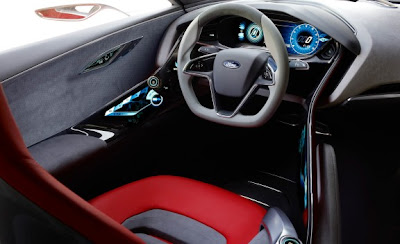
Good genes: Ford’s Frankfurt debutant defines a new design language for its global products.

BY STEVE SILER


At the 2005 Frankfurt auto show, Ford’s stunning Iosis concept car debuted the company’s “Kinetic” design language, which shortly thereafter debuted on non-U.S. models like the Mondeo, European Focus, C-Max, and Kuga. Our first taste of Kinetic design came more recently with the 2011 Fiesta and 2012 Focus models. But now Ford’s look is evolving, with another Frankfurt concept—the 2011 show’s gorgeous and aptly named Evos—previewing the next evolution (get it?) of Blue Oval design.


Sadly, the company won’t go so far as to adapt the Evos’s quad butterfly doors for production. But this fastback four-seater, which is shorter than a Focus sedan but wider than a Porsche Panamera, does embody a half dozen newly defined pillars of Ford global design—which will drop the Kinetic moniker. The Evos will provide the template for future Fords, and so we took a virtual tour of the car with Ford design chief J Mays, who explained those design pillars.


Ford’s New Global Design Language, Explained

The first two pillars of Ford’s new design language are “silhouette innovation” and “perceived efficiency.” The former, according to Mays, represents a profile “that defines your automobile and looks different than most of the other cars in a particular class on the road,” while the latter equates to visual lightness and sleekness. “We’d like to have lightweight pillars [and] a teardrop cabin [where] the lines on the side disappear at a vanishing point somewhere around 100 yards behind the car.” The gist? Think less ‘traditional three-box sedan’ and more ‘four-door coupe.’


“Refined surface language” refers to a smoothing out of Kinetically sculpted body surfaces, among them the architectural fenders, creased door skins, and sculpted hoods. This directive also appears to be a reaction to other manufacturers that Mays claims have “annexed” and subsequently exaggerated Ford’s Kinetic motifs. Ford is going in “exactly the opposite direction” now, he said, keeping what he called the “excitement” of Kinetic design but rendered in “beautiful shapes you’d love to run your hands over.”


An emphasis on the fourth pillar, “technical graphics,” basically refers to the lamps and lower body addenda. “Headlamps seem to be growing to absurd proportions,” said Mays. “They’ve become less about technology and more about design flourish and style. And we think that’s reached its complete evolution. So we’re going to the minimal height for the headlamps and the taillamps and we’re going to let the technology speak for the graphics rather than overt style.” The headlamps on the Evos are rendered in LEDs “designed in such a way that you probably haven’t seen before.” Will every future Ford model get “razor-cut” headlamps such as these? Yes, and Mays told us that he is committed to LED headlamps on every new Ford, although we’ll have to see if those make it past the accountants.


The final two newly defined design-isms are the “new face of Ford,” which involves pulling the trapezoid grille way up to the leading edge of the hood (it gives the Evos a sort of Mustang-esque shark nose), and a “visual sense of premium quality,” which—besides being less catchy than the others—basically means creating the sort of designs people associate with higher-end cars. “We’ve tried to eliminate one of the grilles on the vehicle, and focus on the other. And what that does is allow us to have a smaller inlet, gives us better aerodynamics, and also, I think, looks much more premium.”


If roadgoing Fords end up looking like the Evos, we say “mission accomplished” to the premium bit. Indeed, more than a few of us think that the “new face of Ford” looks a lot like the current face of Aston Martin, particularly, the slim, six-sided grille and Rapide-esque roofline. Could Ford be suffering from a case of “seller’s remorse” after getting rid of Aston Martin during the great fire sale of 2008? Mays didn’t admit any such—to borrow his own term—annexation of Aston’s designs, but when asked about the similarities, he seemed rather comfortable with the comparison.


Head in the “Cloud”

However Aston-y the Evos looks, it wouldn’t be a show car if it didn’t contain a boatload of future tech. Cloud-based connectivity supposedly helps the Evos identify and pre-arrange its various systems to match the preferences of the upcoming drive, thus promising “seamless connectivity” from home to car to office, which may or may not be a good thing. It also gauges the skills of the driver and, reconciling them with weather and road conditions, adjusts the powertrain and chassis to maintain “optimum safety”—which sounds a bit Hal 9000 to us. Then there are the “driver wellness” features, too, which include a heart-rate monitor; the car is able to use current and previous data via the cloud to monitor “the physical state and workload of the driver and adjusts the driving experience accordingly.” To the good, if you start driving aggressively, the Evos will also simplify the gauge cluster to provide only necessary info and switch the driver’s phone to “do not disturb mode.”


The Evos is powered by—what else?—the cloud. Just kidding. It features a lithium-ion-based, plug-in gas/electric powertrain that’s said to be able to deliver extended-range or parallel-hybrid propulsion, ultimately delivering the same sort of fuel economy as the Ford C-Max Energi that’s scheduled to arrive stateside next year. Ford gave no more details on the powertrain beyond this: The cloud would theoretically be heavily involved, directing the car when to make various on-the-fly powertrain adjustments, such as switching to electric mode when driving into a city center that may have emissions restrictions.


We won’t have to wait long to see the look previewed here on a saleable Ford product. The 2013 Fusion will be the first Ford to wear the new design language; we expect to see that car next January at the Detroit show. In the meantime, if you can make it to Frankfurt, check out the Evos—it’s a stunner.


Source;

http://www.caranddriver.com/news/car/11q3/ford_evos_concept-auto_shows


, , , , , , , , ,

Honda Cars : Designer Ciprian Cooks up Ford Cobra 'Snakehead' Concept | 2013 New Honda Car Reviews 0

Unknown | 6:44 AM
Ford Concept
Ford Concept

Wow, what a sleek design! I love the 77' Stingray rear side profile homage....
A new Ford concept has been released courtesy of designer Andrus Ciprian, dubbed the Cobra Snakehead.

The concept draws inspriation from past and current Ford models, so it fits in with the brand’s existing line up. Yet Ciprian adds some strong lines and distinctive features that make this one outstanding car.

The exterior leaves a lasting impression. Its rear end draws parallels with the first GT40′s, and the body also boasts massive wheel arches and other bold styling elements. Ford’s latest Focus model has some influence that can be seen in the front end. On the inside of the concept, two seats are divided by an excessive center console so each person gets the feel of a cockpit of their own.

To power the Cobra Snakehead, the designer suggests that a front mounted V8 would be fitting.

We hope Ford will take this concept into consideration for future models. The exterior design elements can certainly lend themselves to mass appeal, where as the interior concept may only work for some enthusiasts.

Source;
http://www.egmcartech.com/2011/07/05/ford-cobra-snakehead-concept-by-ciprian-is-a-beautiful-dream/


, , , , , , ,

Honda Cars : Amatoya: A Fire-Fighting Ford Warthog Concept | 2013 New Honda Car Reviews 0

Unknown | 7:37 AM
Ford Concept
Ford Concept

I think I just found my next vehicle....
The Amatoya may be just a concept Warthog-inspired reconnaissance and fire-suppression vehicle, but with Apache-like seating and robotic water cannons it makes us want to see it douse some fires.

Designed by Liam Ferguson, the system is similar to an MRAP and is designed to fill in as a quick response vehicle smaller than currently used commercial trucks. We're not sure there's a large enough market to justify the creation of such a vehicle, but we dig the look and the ethos of reducing human vulnerability. Just swap out the water cannons for real ones and you've got a great assault vehicle.

Here's what the designer has to say:

"Currently the role of site reconnaissance is predominantly carried out by light tankers or QAVs (Quick Attack Vehicles), typically these are modified single cabin commercial utility vehicles such as the Toyota Landcruiser. While the off road performance and maneuverability of such a vehicle is sufficient, its ability to actively suppress a fire threat is severely limited by the considerably small water supply (500lt) and distinct lack of survival engineering, fundamentally making it inadequate for its role.

CREW LAYOUT
Typically medium and heavy tankers require 5-6 crew members to be operated effectively. AMATOYA requires only 2. More military in its approach, reducing crew numbers per appliance will allow for greater dispersion of resources during a fire response.

Principal concerns when developing a vehicle of any nature are driver position, ingress/egress and vision angles. These elements become even more crucial in a vehicle purpose built for reconnaissance. A central, forward and high driver and ROSCO operator position akin to the Apache assault helicopter with generous down vision will assure functionality.

Access is via two gull wing doors, an optimal solution to accommodate the unconventional bodyside form. The distinct lack of a traditional b-pillar will provide uninterrupted views for the ROSCO operator situated above and behind the driver.

SURVIVABILITY
Cabin temperature and vehicle survivability are central to the AMATOYA concept. Existing approaches in survival engineering on fire tankers consistently appears as augmentation rather than integration. Methods are passive, typically reactive and often incapacitate the appliance when in use. A key example is the use of curtain heat shields, while effective, when employed render the appliance out of operation.

To create a homogenous directive towards survivability AMATOYA incorporates state of the art clear aerogel laminated insulation in the windows and bodywork, a dedicated auxiliary water supply to operate a highly efficient, intelligent temperature controlled spray down system, military grade sacrificial thermo ceramic intumescent paints, and a mechanically injected large displacement diesel engine specifically engineered for the unique conditions experienced on the fire ground.

These measures will assure that even in the case of an extremely prolonged and high intensity burnover the vehicle will not only maintain cabin integrity, but opposed to existing appliances AMATOYA will remain fully operational.

SUPPRESSION ABILITY
A Remotely Operated Suppression Cannon Outfit (ROSCO) coupled with a generous 1800lt + 400lt auxiliary water supply, offers a unique dynamic to vehicle operation. Current suppression techniques require large crew numbers (at least 5 per appliance) to perform through intermittent periods of strenuous labour to have any form of impact on a fire. The ROSCO system utilizing IFEX3000 impulse technology is not only a hugely efficient means of fire suppression, but vitally will eliminate crew members being subjected to the elements and stresses of extended high intensity work on the fire ground, while constantly maintaining vehicle mobility. A highly rated thermal imaging camera along with directional spot lights will assist in ‘hotspot' location to determine the most effective direction of attack.

OFF ROAD PERFORMANCE
AMATOYA represents the pinnacle of specialized performance in the fire appliance design field. Off road capabilities reflect enthusiast 4WD methods, including generous approach, departure and over ramp angles, suspension travel, ground clearance and minimized turn circle.

Central tire inflation (CTI) and run flat tire (RFT) technology coupled with beadlock tires will allow an extensive band of dynamic pressure control to aid in traversing the complex terrain often encountered on the fire ground.

MANUFACTURING
The vehicle adopts many conventional fabrication techniques associated with low production run specialized vehicles. The point of difference which separates this concept from existing appliances is the proposed monocoque steel body, comparable to military MRAP vehicles. A conventional fire tanker is built body-on-frame from a standard cab chassis truck base. While this approach is successful, the lack of integration results in certain performance issues. Body roll due to the on board water supply is an notable problem, however by creating a fully integrated solution, water reservoirs can be strategically located central and low in the vehicle to dramatically improve the centre of gravity.

Source;
http://jalopnik.com/5435764/amatoya-a-fire+fighting-ford-warthog-concept


, , , , , , , ,

Ford Concept Ford Concept